
Qwen 4 Max: What Alibaba's new AI model can do, what it costs and how to use it in Claude Code
Do you really always need the most expensive model for your AI agents, or are you currently paying for performance you don't even use on half your tasks? That question is being asked afresh right now, because on 16 November 2026 Alibaba released its new flagship model Qwen 4 Max, officially Qwen4-Max, and it is tuned above all to get long tasks done with fewer tokens.1,9 That means you get a model with 2.4 trillion parameters and a context of one million tokens, which you can plug straight into Claude Code, Cursor or Qwen Code via OpenAI- and Anthropic-compatible interfaces, and which in Alibaba's own test costs 62% less per task than its predecessor.1,2,4 In this article I'll show you what Qwen4-Max can really do, what you pay for it in euros, how to set it up in Claude Code in a few minutes, what it's worth in a small business or agency and where you need to look closely at data protection.
Qwen4-Max is the new flagship of Alibaba's Qwen family, built for programming, office work, web design and long agent tasks.2 It reads text, images and videos, but only replies with text. There are no open weights, so you can only use it through the cloud.1,2 Via the Qwen API in Singapore it costs US$1.50 per million input tokens and US$4.50 per million output tokens, or you can take the Token Plan as a subscription from US$6 a month.2,4 It shows its strength above all when it works as an agent in a tool such as Claude Code, and not just when it answers individual chat questions. For confidential data you should look closely, because Qwen4-Max runs as “Global” in Frankfurt and in the Token Plan, and that may also use data centres in mainland China.2,4,8
The key figures
- 16/11/2026: Alibaba releases Qwen4-Max, after a preview that had been running since 11 November.4,9
- 2.4 trillion parameters at the core of the model, of which 71 billion are active per token.1
- 1,000,000 tokens of context, up to 262,144 tokens of output with thinking mode.2
- US$1.67 instead of US$4.43 is what one task costs in Alibaba's own Work360 test, which is 62% less than with the predecessor.1
- US$1.50 / 4.50 per million input and output tokens via the API in Singapore, in Frankfurt US$1.413 / 4.24.2
- US$6 a month is the cost of the smallest Token Plan, US$3 for new customers in November.4
What is Qwen4-Max?
Qwen is the Alibaba AI model family from Alibaba Cloud and, alongside DeepSeek and Kimi, is one of the best-known Chinese AI models. Qwen4-Max is the first model of the fourth generation, in other words of Qwen 4. Alibaba calls it an “AI teammate” that keeps working on projects around the clock and doesn't just answer individual questions.1 The foundation is a so-called mixture-of-experts model, which means that of the 2.4 trillion parameters at its core, only a portion of 71 billion does the computing for each token. On top of that come 328 billion parameters for an additional word-pattern memory that costs hardly any computing time. So you get the capacity of a huge model without the whole network firing up for every token, and that keeps computing costs in check.1
The architecture is new. Alibaba combines a fast attention mechanism, which packs long histories into compact intermediate states, with a targeted selection of the relevant passages of text. For you, that means the model needs much less computing effort even with very long documents or conversations.1 Compared with its predecessor Qwen3.8-Max, the base model does better in Alibaba's own tests in all four areas examined (knowledge, code, question answering and STEM) while activating 25% fewer parameters.1
It's also worth putting into context that Qwen4-Max is a closed model. You can't download it and you can't run it on your own machine. Alibaba does announce that smaller models of the Qwen4 family are to follow as open source. There's no date for that yet.1 Besides the API and the Token Plan, according to Alibaba you can also try Qwen4-Max in its own applications QwenStudio, QwenWork and Qoder.1
What can Qwen 4 Max do? Features at a glance
According to the model page, Qwen4-Max is intended for programming, office work, front-end design and complex agent tasks.2 An agent here is an AI that works through a task itself in many steps, so it opens files, runs commands, checks results and carries on until the job is done. If the term is new to you, you'll also find it in the glossary under AI agent.
| Feature | Qwen4-Max |
|---|---|
| Input | Text, images, video |
| Output | text only |
| Context | 1,000,000 tokens, of which a maximum of 991,808 tokens of input without and 983,616 tokens with thinking mode |
| Maximum output | 131,072 tokens without, 262,144 tokens with thinking mode |
| Thinking mode | on by default, levels low, high (default) and xhigh |
| Tool calls | yes, including several in parallel |
| Web search | yes |
| Structured output (JSON) | yes |
| Cache | yes, 5 minutes or 1 hour |
| Interfaces | OpenAI- and Anthropic-compatible |
| Batch processing | no |
| Fine-tuning | no |
| Open weights | no |
Sources: model page and API documentation from Alibaba Cloud, as of 17/11/2026.2,3
On two points it's worth taking a close look at the documentation, namely batch processing and fine-tuning. For both, the official model page explicitly says “not supported”.2 So if you want to generate thousands of product descriptions overnight in a batch, Qwen4-Max isn't currently the right model for it.
I find the examples Alibaba shows itself interesting, because they make clear where things are heading. The model reportedly builds 3D scenes in Blender, develops games in Unity, Unreal and Godot, launches them itself along the way and then improves camera, animation and lighting. In one legal-advice case, it renamed 198 unsorted working papers by content, sorted them into 14 folders, created an index and wrote an 86-page review report from them, in which every statement points to the matching document.1 Then there's the “Live Delivery” principle, which means that on long tasks an agent delivers a first usable version early and then builds it out piece by piece, while you can step in at any time and change direction.1
Qwen4-Max benchmarks: what the numbers say and what they don't
For Qwen4-Max, Alibaba developed its own test called Work360, which covers 26 main areas, 182 sub-areas and 721 specialist fields. There Qwen4-Max scores 52.69 points, the predecessor 47.74.1 Token consumption looks even clearer, because on Work360 the new model needs 24 to 35% fewer tokens depending on the thinking level, and on Terminal-Bench 4.0 even around 48 to 49% fewer.1
You should put these numbers into the right context, though. Work360 is Alibaba's own test, and which comparison tests end up in the big overview is also decided by Alibaba. In independent rankings, Qwen4-Max in my impression sits in the upper midfield, so strong for a Chinese model and clearly better than its predecessor, but not at the top ahead of the big models from Anthropic, OpenAI and Google. Especially for tasks in the terminal, meaning working with commands on the command line, other models are further ahead.
Then there's a point that gets lost in many comparisons, namely the thinking level. Without any setting, Qwen4-Max works at the high level. The highest level, xhigh, thinks for longer, can deliver better results on hard tasks and uses more tokens.2 That means when you compare figures, always check which level was used for the measurement, because your own result depends heavily on it. My advice, as with any new model, is to run two or three of your real tasks through it before you commit.
What does Qwen 4 Max cost? Qwen API and Token Plan pricing in euros
You have two ways to pay for Qwen4-Max, and which one suits you better depends on how you use it. I converted the euro values at roughly €0.86 per US dollar; billing is in US dollars.
Option 1: Pay as you go via the API. You pay per million tokens and can build the model into your own programs, automations or tools.2
| Region | Input per 1m tokens | Output per 1m tokens |
|---|---|---|
| Singapore (International) | $1.50 (approx. €1.29) | $4.50 (approx. €3.87) |
| Frankfurt (Global) | $1.413 (approx. €1.22) | $4.24 (approx. €3.65) |
Source: Alibaba Cloud, Qwen4-Max model page, as of 17/11/2026.2
In thinking mode, the model's reasoning counts as output, and output is the more expensive part. If, for example, you let an agent build a landing page and it reads 1.5 million tokens and writes 60,000 tokens in total, you end up at about €2.17 in Singapore without the cache. With agents, input weighs in most, because at every step they re-read the history so far, and that's exactly where the cache helps, which Qwen4-Max offers for five minutes or one hour.2,3 In the Singapore region there's also a free allowance that is valid for 90 days. How big it is isn't stated on the model page, though.2
Option 2: The Token Plan as a monthly subscription. Here you pay a fixed amount and get an allowance of credits that you use up in tools such as Claude Code, Cursor, Qwen Code or Codex.4 Credits aren't the same as tokens. A more expensive model uses more credits for the same work.5
| Token Plan | Price per month | Credits per month | Recommended concurrent agents |
|---|---|---|---|
| Lite | $6 (approx. €5.16), $3 (approx. €2.58) for new customers in November | 20,000 | 1 to 2 |
| Essential | $10 (approx. €8.60), $5 (approx. €4.30) for new customers in November | 45,000 | 2 to 3 |
| Standard | $18 (approx. €15.48) | 80,000 | 3 to 4 |
| Pro | $43 (approx. €36.98) | 200,000 | 6 to 8 |
Source: QwenCloud, Token Plan Individual, as of 17/11/2026.4
There are two things you need to know about the Token Plan. First, it's intended only for interactive use in programming and agent tools, so not for scripts, your own applications or automatic workflows, otherwise your key risks being blocked.6 For an automation in n8n or Make you therefore need the API route. Second, a used-up allowance isn't simply billed on a pay-as-you-go basis. Instead, calls are blocked until your next billing month begins or you buy more credits.5 For cost control that's quite pleasant, because there's no surprise waiting for you at the end of the month.
And one more note, in case you're testing the preview right now and are pleased about the low consumption. From 11 to 25 November, the preview version qwen4-max-preview uses only 20% of the normal credits, and between 22:00 and 08:00 Chinese time, which is 15:00 to 01:00 here in Germany, only 8%.4 So for the time after that, you'd better plan on normal consumption.
Setting up Qwen4-Max in Claude Code: step by step
I work with Claude Code myself every day, and the nice thing about Qwen4-Max is that you keep your familiar tool and only swap the model behind it. This is how QwenCloud describes the setup via the Token Plan:7
- Sign up for a Token Plan. Create an account with QwenCloud and choose a plan. The Token Plan runs exclusively via the Singapore region, but according to the terms of use as a “Global” deployment with worldwide processing.4
- Generate an API key. In the console, create a dedicated Token Plan key. It starts with
sk-sp-and is shown in full only once. Normal API keys don't work with the plan, and vice versa.5,6 - Configure Claude Code. Open the file
~/.claude/settings.jsonand enter the environment variables.
{
  "env": {
    "ANTHROPIC_AUTH_TOKEN": "DEIN_TOKEN_PLAN_SCHLUESSEL",
    "ANTHROPIC_BASE_URL": "https://token-plan.maas.qwencloudapi.com/apps/anthropic",
    "ANTHROPIC_MODEL": "auto",
    "ANTHROPIC_DEFAULT_OPUS_MODEL": "qwen4-max",
    "ANTHROPIC_DEFAULT_SONNET_MODEL": "qwen3.8-flash",
    "ANTHROPIC_DEFAULT_HAIKU_MODEL": "qwen3.6-flash",
    "CLAUDE_CODE_SUBAGENT_MODEL": "auto",
    "CLAUDE_CODE_MAX_CONTEXT_TOKENS": "983616"
  }
}
- Test. Open a new terminal and enter
claude -p "Hallo". If a reply comes back, the connection works.7 - If replies get cut off, also add
"CLAUDE_CODE_MAX_OUTPUT_TOKENS": "131072".7
A few stumbling blocks to go with that. If Claude Code asks for an Anthropic login on startup, according to QwenCloud you can set the value "hasCompletedOnboarding": true in the file ~/.claude.json.7 Also make sure you use the Token Plan key and the Token Plan address. If you accidentally use a normal API key, you'll be billed pay-as-you-go, and according to QwenCloud that can't be offset against the subscription afterwards.5 And don't be surprised if Claude Code shows less consumption than the QwenCloud console. System instructions, tool descriptions and the model's reasoning all count, but don't show up in Claude Code.5
If you'd rather connect Claude Code via the pay-as-you-go API route, you use a normal API key from Alibaba Cloud Model Studio instead of the Token Plan key, along with the Anthropic-compatible address of your workspace, for Singapore for example https://{WorkspaceId}.ap-southeast-1.maas.aliyuncs.com/apps/anthropic, where you replace {WorkspaceId} with the ID of your workspace. As the model, you again enter qwen4-max.3 The same logic applies to Cursor, Cline and other tools that allow their own base address and their own key.4
What Qwen4-Max is worth in your business
First, one thing that particularly struck me about Qwen4-Max. The model plays to its strengths when it works as an agent in a tool, meaning with planning mode, file access and the ability to check its own result. A single chat request along the lines of “build me a website” often delivers fairly bland results. If, on the other hand, you give the model a clean requirements brief and let it plan first and then build, the difference becomes clear.
1. Landing pages and dashboards for clients
For agencies this is probably the most obvious use. You give the agent a short requirements document with target group, offer, colours and sections, let it propose a structure in planning mode and then build. Especially for interactive elements such as a price calculator that updates depending on the package chosen, or a dashboard with sortable tables and filters, the model delivers solid work. Details such as truncated text in tiles usually still need correcting afterwards, but that goes quickly.
2. Sorting the mountain of documents
You probably know it. A client sends you 40 files with names like “Scan_0034.pdf” and “final_neu2.docx”. An agent with Qwen4-Max reads all the files, renames them by content, sorts them into folders, creates an index and notes what it notices, for example duplicate invoices or totals that don't add up. Alibaba also shows this type of task with the legal-advice case.1 Thanks to the large context, the model has a great deal of material in view at once. But don't let it delete anything; let it only rename and sort copies, and check the findings yourself.
3. Analysing screenshots and videos
Because Qwen4-Max understands images and videos, you can, for example, give it screenshots from Google Ads, Search Console or your analytics tool and have it explain the most striking changes. Or you give it a screen recording of your ordering process and have it point out places where customers might get stuck. The model doesn't generate images or videos in the process; it replies with text only.2
4. Long documents in one go
One million tokens of context is enough for several books at once. For you, that means you can feed in complete tender documents, an entire manual or all the pages of your website at once and ask questions about them, without splitting everything into bite-sized pieces first. Just note that every million tokens read costs around €1.22 to €1.29 via the API. Having large documents read several times therefore gets expensive.2
5. As a cheap second agent alongside your main model
You don't have to decide on one model. Many tasks in a business are routine, so rebuilding texts, preparing tables or writing code to a clear plan. For those, Qwen4-Max can run as the cheaper model, while for the tricky tasks you keep using your current top model. So if you're looking for a cheap alternative to the Claude models, you don't have to leave Claude Code for it, you just swap the model behind it. But expect Qwen4-Max to often take longer for the same task than the fastest models. If a result has to be there within a few minutes, you'll notice.
Data protection: where does your data run with Qwen4-Max?
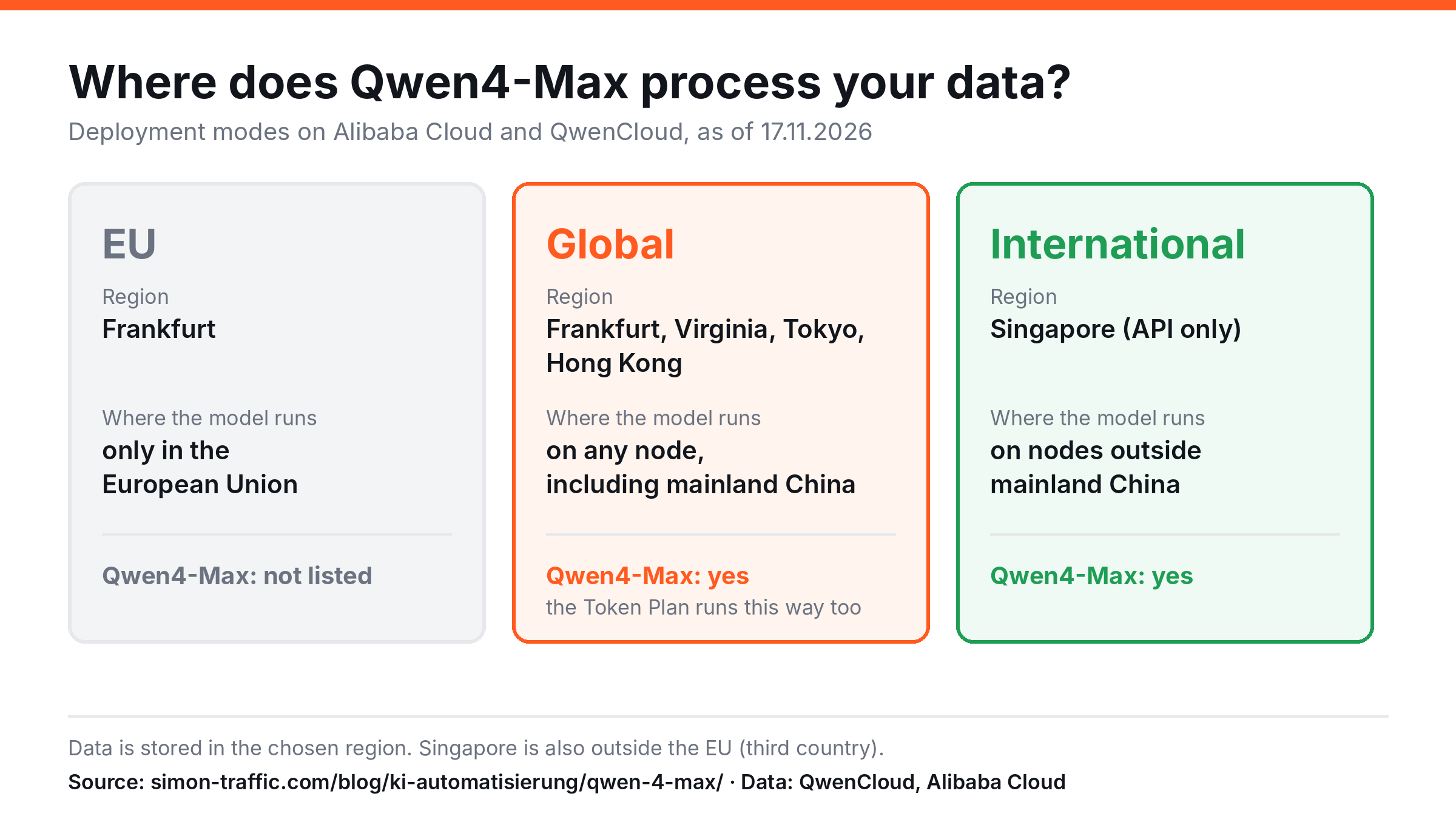
For me this is the most important question before client data goes into a model, and with Alibaba it's worth a close look. When it comes to the region, Alibaba Cloud distinguishes two things, namely where your data is stored and where the model computes. Storage is in the region whose address you call. Where computing happens depends on the deployment type.8
| Deployment | Region | Where the model computes | Qwen4-Max available |
|---|---|---|---|
| EU | Frankfurt | only in the European Union | not listed (as of 17/11/2026) |
| Global | Frankfurt, Virginia, Tokyo, Hong Kong | on any available node, including mainland China | yes |
| International | Singapore | on nodes outside mainland China | yes |
Sources: QwenCloud, Regions and endpoints, and Alibaba Cloud, Qwen4-Max model page, as of 17/11/2026.2,8
Use the graphic on your site
You may use the graphic freely with attribution. To do so, copy this code:
<a href="https://simon-traffic.com/en/blog/ai-automation/qwen-4-max-pricing-claude-code/"><img src="https://simon-traffic.com/assets/blog/qwen-4-max/qwen-4-max-datenschutz-regionen.en.png" alt="Where does Qwen4-Max compute your data? Deployment types at Alibaba Cloud" width="1200" height="675"></a>
<p>Source: <a href="https://simon-traffic.com/en/blog/ai-automation/qwen-4-max-pricing-claude-code/">Simon Traffic, Qwen 4 Max: features, pricing and data protection</a></p>
In plain terms, the Frankfurt address sounds like Europe, but for Qwen4-Max it's classed as “Global”, and that means the computing may also take place in China. Alibaba does have a pure EU variant, but Qwen4-Max isn't listed there so far.2,8 It's similar with the Token Plan, which runs via Singapore but, according to its terms of use, as “Global”, which means the computing takes place worldwide. Mainland China isn't explicitly excluded, and for Alibaba's “Global” regions it is otherwise explicitly part of the picture.4,8 If it matters to you that your requests aren't processed in mainland China, the only suitable choice at the moment is the API with a workspace in Singapore, so “International”, even if it's a few cents more expensive. You set the deployment type when you create the workspace, and it can't be changed afterwards.8 Bear in mind that Singapore is also outside the EU, so a transfer to a third country takes place in any case.
With the Token Plan there's a second difference. In the team version, according to QwenCloud, conversation data isn't used for training; for the individual version, QwenCloud refers to the rules in the service agreement.6 For client data I'd therefore either take the team version or read the service agreement thoroughly beforehand. And as with any cloud model, for personal data you need a data processing agreement and a proper assessment of the transfer to third countries. For very sensitive documents, a local model is often the better choice. I show you how that works in my article on Google Antigravity with local models.
My tips for getting started with Qwen4-Max
- Use it as an agent, not as a chat. Let the model work in Claude Code, Qwen Code or another tool with planning mode. A short requirements document with goal, target group and limits gets you far more than one long single prompt.
- Choose the thinking level deliberately. For simple tasks low is enough, the default is high, and xhigh is worth it for the hard cases. More thinking means more output tokens and therefore higher costs.2,5
- Start with the smallest plan. With the Lite plan for US$6, or even US$3 for new customers in November, you can test the model on your real tasks without risking much.4
- Your own tests instead of other people's rankings. Take two or three tasks you do regularly and compare result, time and cost with your current model.
- Allow for patience. Long agent tasks with Qwen4-Max often take longer than with the fastest models. Let them run in the background instead of sitting in front of them.
- Decide on the region before your first client project. The Token Plan and Frankfurt run as “Global”; only the API route via Singapore runs as “International”, outside mainland China. With the API route you decide this once, when you create the workspace.4,8
- Check the results. Especially with figures, facts and code, you shouldn't take anything on unread. The model sometimes describes what it meant to do, and not what it actually tested.
Limits of Qwen4-Max
- Not an open model. You depend on Alibaba's cloud; Qwen4-Max doesn't run locally.1
- No batch processing and no fine-tuning via Alibaba Cloud.2
- Text output only; the model understands images and videos but doesn't generate them.2
- Vendor figures. The big numbers from the announcement come from Alibaba's own tests, and Alibaba itself chooses which comparisons are shown.1
- Token Plan for interactive use only. For automations and your own applications you need the API route.6
- Data protection. In Frankfurt and in the Token Plan, Qwen4-Max runs as “Global” with possible processing in China, and there is no pure EU variant for this model yet.2,4,8
Conclusion
Is Qwen 4 Max now the best AI model? No, others are still at the very top. But in my view that isn't the point, because Qwen4-Max is a very strong workhorse at a price where you can let it work on a task for many steps without a guilty conscience. For agencies and small businesses that build landing pages, dashboards or document sorters with Claude Code or similar tools, it's a real option, above all as a cheap second model alongside the one you already use. I would start with the smallest Token Plan, compare two or three real tasks and set the region deliberately before the first client project. And if you notice along the way that your business holds many more tasks like these, let's have a quick chat about which one is worth tackling first.
Frequently asked questions about Qwen 4 Max
What is Qwen 4 Max?
Qwen4-Max is Alibaba's new flagship model from the Qwen4 family, released on 16 November 2026. It has 2.4 trillion parameters, a context of one million tokens and is built for programming, office work, web design and long agent tasks.1,2
Is Qwen 4 Max free?
Not permanently, but it's cheap. Via the API in Singapore you pay US$1.50 per million input tokens and US$4.50 per million output tokens. The Token Plan starts at US$6 a month, US$3 for new customers in November.2,4 For the API there's a free allowance in the Singapore region that is valid for 90 days.2
Is Qwen 4 Max open source?
No. Qwen4-Max is a closed model that you can only use via Alibaba's cloud. According to Alibaba, smaller Qwen4 models are to follow as open source. There's no date yet.1
Where can I try Qwen 4 Max?
Alibaba names QwenCloud with Token Plan or API as well as its own applications QwenStudio, QwenWork and Qoder.1 Whether and for how long the model can be used there for free isn't stated in the announcement. The cheapest way to test it is as a new customer in November with the Lite plan for US$3.4
Can I use Qwen 4 Max in Claude Code?
Yes. Qwen4-Max has an Anthropic-compatible interface. In the file ~/.claude/settings.json you enter QwenCloud's Token Plan address, your key and qwen4-max as the model, and Claude Code then runs with Qwen4-Max in the background.7
Does Qwen 4 Max also work with Cursor and Cline?
Yes, any tool that allows its own base address and its own API key under the OpenAI or Anthropic standard can use Qwen4-Max. QwenCloud explicitly names Claude Code, Cursor, Qwen Code, Codex, Qoder and OpenClaw.4
Is Qwen 4 Max GDPR-compliant?
That depends on your setup. In Frankfurt and in the Token Plan, Qwen4-Max runs as a “Global” variant, in which data centres in mainland China may also be used. Only via the API with a workspace in Singapore does the model compute outside mainland China.2,4,8 For personal data you additionally need a data processing agreement and an assessment of the transfer to a third country, because Singapore is also outside the EU. For sensitive data, a local model is often the safer choice.
What is the difference between the Token Plan and the API?
The Token Plan is a monthly subscription with a fixed allowance for interactive use in tools such as Claude Code or Cursor. The API bills by consumption and is intended for your own programs and automations. According to QwenCloud, using the Token Plan for scripts or automatic workflows is not permitted.6
Suggested citation
Gütter, Simon (2026): Qwen 4 Max: What Alibaba's new AI model can do, what it costs and how to use it in Claude Code. Simon Traffic, 17 November 2026. https://simon-traffic.com/blog/ki-automatisierung/qwen-4-max/
Sources
- Qwen Team: Qwen4-Max: Your New Teammate Has Arrived, November 2026. https://qwen.ai/blog?id=qwen4-max
- Alibaba Cloud Model Studio: Qwen4-Max, model page with features, prices and regions, accessed on 17/11/2026. https://www.alibabacloud.com/help/en/model-studio/qwen4-max
- Alibaba Cloud Model Studio: Anthropic API compatible, Messages, accessed on 17/11/2026. https://www.alibabacloud.com/help/en/model-studio/anthropic-api-messages
- QwenCloud: Token Plan, overview and Individual plans, accessed on 17/11/2026. https://docs.qwencloud.com/token-plan/personal/token-plan-personal-overview
- QwenCloud: Token Plan, Usage and quota, accessed on 17/11/2026. https://docs.qwencloud.com/token-plan/token-plan-usage-quota
- QwenCloud: Token Plan, Permissions and usage policy, accessed on 17/11/2026. https://docs.qwencloud.com/token-plan/token-plan-permissions-and-usage
- QwenCloud: Claude Code, setup guide, accessed on 17/11/2026. https://docs.qwencloud.com/developer-guides/clients-and-developer-tools/claude-code
- QwenCloud: Regions and endpoints, accessed on 17/11/2026. https://docs.qwencloud.com/developer-guides/getting-started/regions
- QwenCloud: Model releases, changelog, entry of 16/11/2026, accessed on 17/11/2026. https://docs.qwencloud.com/changelog/models
As of: 17 November 2026. Prices, plans and regions at Alibaba Cloud and QwenCloud may change; euro values are converted at roughly €0.86 per US dollar.