
How to Implement AI in Your Business: 6 Stages from Trying It Out to Your Own Agent
57 per cent of companies in Germany with at least 20 employees now use AI. Yet no company using AI says it is exploiting the potential in full, and 59 per cent say they are not exploiting the possibilities at all.1 Smaller businesses are further behind still. According to the German Federal Statistical Office, only 23 per cent of companies in Germany with 10 to 49 employees used AI in 2025. Those that had considered AI but not introduced it most often named a lack of knowledge as the reason.2 In this article I show you the stages through which AI really arrives when you implement AI in your business, what holds companies back between the stages, and how to find out where you stand in three minutes with the readiness check.
A few ChatGPT logins don't mean AI has arrived in your business. Many small firms are only at stage 1 or 2. A few people experiment, and good prompts get passed around the office by word of mouth. The big leap comes when your company knowledge lives in one place and the AI works directly inside your software. From there, your own agents for fixed processes such as appointment requests, quotes or receipts really save time. You don't have to dive deep into the technology to get there. What matters more is that you know where the time goes in your day-to-day work, which data may go where, and that the team is on board.
The key figures
- 57 % of companies in Germany with 20 or more employees use AI, compared with 20 % in 2024.1
- 23 % of companies in Germany with 10 to 49 employees used AI in 2025, compared with 57 % of companies with 250 or more employees.2
- 73 % of small firms that considered AI but have not deployed it name a lack of knowledge as the reason.2
- 66 % of companies rate their employees' AI skills as low.1
- 48 % of AI users were able to speed up internal processes significantly with it.1
- 11 % already use AI agents, and another 29 % plan to.1
Why a licence is not the same as implementing AI
It often goes like this. Management buys AI access for everyone, a few people are enthusiastic, and most try it twice. Six months later the AI writes the odd email, but nothing about the processes has changed.
The biggest difference I see is between AI as a convenience and AI inside your processes. An email drafted faster saves a few minutes. An appointment request that lands in the calendar without anyone retyping it saves hours every week. And for that, it has to be clear beforehand how the process actually works. In many small businesses it isn't written down anywhere. It lives in the head of the boss or an experienced employee.
That matches the figures. Those already using AI name data protection (66 %), legal uncertainty (56 %) and lack of acceptance in the team (42 %) as the biggest hurdles.1 These are not technical problems. And those not yet using AI mainly fail because of a lack of knowledge.2 So plan at least as much time for your team as for the technology. Explain why you are using AI, give people room to experiment, and be honest that it means more work at first, in the first few weeks.
The 6 stages to implement AI in your business
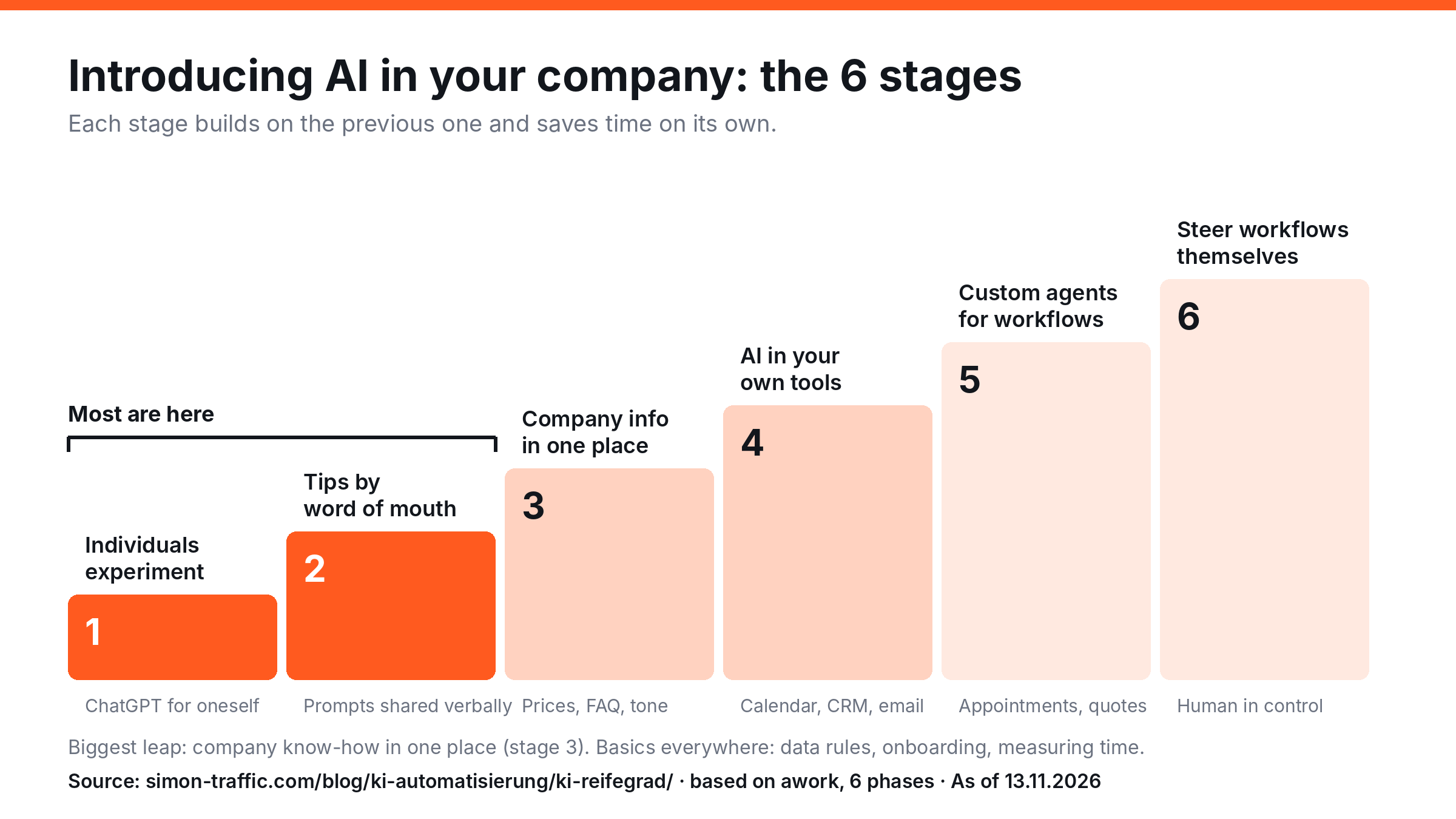
An AI maturity model shows how far AI has come in a business, from loose experimentation to fixed processes. As a basis I use the six-phase model that the Hamburg-based software company awork described for agencies. According to awork, most agencies are in phase 2.3 I have adapted the model for small businesses such as practices, trades, service providers and retailers. I have also added where my own automations got stuck at first.
| Stage | What it looks like | What usually holds it back |
|---|---|---|
| 1. Individuals experiment | Individuals use ChatGPT and the like for writing and research, each on their own | no rules, private accounts |
| 2. Tips by word of mouth | AI has arrived in everyday work, good prompts are shared verbally | knowledge sits in heads and chat histories |
| 3. Company knowledge in one place | Services, prices, processes, templates and tone of voice are stored centrally, and the AI works with them | nobody feels responsible for maintaining it |
| 4. AI in your own tools | The AI looks things up in the calendar, CRM or mailbox and creates drafts | missing interfaces, data transferred by hand |
| 5. Your own agents for fixed processes | An agent handles a process, such as appointment requests, and a person signs it off | unclear approvals, figures not checked in code |
| 6. Processes that run themselves | Several processes interlock, and people handle exceptions | no measurement of whether it pays off |
Use the graphic on your own site
You are free to use the graphic as long as you credit the source. Just copy this code:
<a href="https://simon-traffic.com/en/blog/ai-automation/implement-ai-in-your-business/"><img src="https://simon-traffic.com/assets/blog/ki-reifegrad/ki-reifegrad-6-stufen.en.png" alt="The 6 stages of implementing AI in your business" width="1200" height="675"></a>
<p>Source: <a href="https://simon-traffic.com/en/blog/ai-automation/implement-ai-in-your-business/">Simon Traffic, How to implement AI in your business</a></p>
You don't have to jump from stage 2 to stage 6. Each stage saves time on its own, and each builds on the one before.
Stage 1: Individuals experiment
Almost every company starts here, and that's fine. The only important thing is that no customer data ends up in AI tools at this stage. As long as there is no rule, everyone decides for themselves what to copy into a chat window.
Next, have people test simple tasks, such as writing emails or summarising long texts. Make a note of which tasks come back every week.
Stage 2: Tips by word of mouth
The AI is used regularly, but everyone uses their own tool and their own tricks. Good prompts vanish into private chat histories.
Next, agree on one tool for everyone, ideally a company account with a data processing agreement rather than private logins. Write down which data may go in. Give everyone a short briefing and collect good prompts in one place.
Stage 3: Company knowledge in one place
The biggest leap happens at this stage. An AI that knows your services, prices, frequent customer questions and your tone of voice writes replies that sound like you and are correct. Without that knowledge, it guesses.
For my own assistant I built a knowledge base that combines semantic search with classic keyword search. In my tests with 30 questions, the right answer was among the top five hits in 93 per cent of cases instead of 73 per cent. Above all, it found identifiers such as contract or case reference numbers reliably. For a small business, though, a well-maintained folder is enough to start with, containing service descriptions, a price list, an FAQ and sample templates that an AI is allowed to read. In a practice, that includes, for example, the rules for prescription and appointment requests. In a trades business, it means hourly rates, call-out charges and standard replies for small jobs.
So write down what makes your company what it is, store it in one place, and name one person to keep it up to date.
Stage 4: AI in your own tools
Now nobody has to copy content into a chat window any more. The AI checks the calendar for free slots itself, reads the customer's status in the CRM and puts a reply in the mailbox as a draft. Interfaces and automation tools such as n8n, Make or Zapier make this possible. In the German Bitkom survey, 72 % of AI users name customer contact as a field of use, for example handling enquiries.1
To get there, first check which of your programs have an interface. Connect a first process, for example contact form to CRM to confirmation email. Your own online appointment booking with an interface is often a good starting point, because appointments eat up a lot of time in almost every small business.
Stage 5: Your own agents for fixed processes
A chatbot answers questions, while an AI agent works through a whole process. A typical example: an email with a quote request comes in. The agent reads it, looks up price and availability, creates a draft quote and gets in touch if something is unclear. A person checks it and sends it off.
Building my own assistant taught me one thing above all: What code can do, code should do. Asked about overdue tasks, the language model named four, but there were 18. Since the database does the counting and the AI only does the wording, it is correct. The same goes for totals, payments and approvals. How I implemented this with a local model is covered in the hands-on test of Nemotron 3.5 Bolt. Why you shouldn't leave payments to agents on their own is explained in the article Letting AI agents pay.
To start, choose a frequent, clearly defined process. Decide what the agent may do on its own and what needs a yes first. Have figures and permissions checked in the program.
Stage 6: Processes that run themselves
At the last stage, several processes interlock. A customer email asking to reschedule an appointment automatically updates the calendar, job scheduling and reminder. People steer, review the key figures and deal with exceptions. For most small businesses this is still the future today, and it doesn't have to be the goal for everything.
If you want to get there, measure for each process how much time it costs before and after, and regularly review where the agents got it wrong.
AI readiness check: where do you stand?
With this AI readiness check you can find out, in 12 questions and about three minutes, which stage your business is at and which step will bring the most next. The check runs entirely in your browser, and nothing is stored or sent.
AI readiness check for small businesses
12 questions, about 3 minutes. You will find out which of 6 stages your business is at and what the next sensible step is. Everything stays in your browser, and nothing is sent.
12 questions still to answer.
Three basics that apply at every stage
1. Count first, then build
Before I automate anything, I look at where the time goes. Which tasks repeat every week? How long do they take? Who does them? Only then is it clear which process is worth using AI for. If you skip this step, you quickly end up automating something that hardly costs any time. This is process optimisation on a small scale, and a week of counting is often enough. How often your team uses the AI says little. As a key figure, what mainly works is how many minutes a process took before and how many it takes now.
2. Rules for data: cloud, EU cloud or local
The question of where data goes decides which tool you use.
| Option | Typical example | When it makes sense |
|---|---|---|
| AI service without a company contract | private ChatGPT or Gemini accounts | only without customer and company data |
| Company account with a data processing agreement | business plans from the big providers, AI via European data centres | for everyday work with personal data, after checking the contract |
| Your own server in Germany | AI models at a German hosting provider | when data should not leave the country |
| Local model | an open model on your own computer | for sensitive data, short answers and fixed processes |
Local models are now small enough for ordinary office hardware, but they have limits. What they can and can't do, I described in the hands-on test of Nemotron 3.5 Bolt. More on running things on your own hardware can be found under self-hosting. This is not legal advice, so if in doubt, have contracts checked.
3. AI literacy: what the EU requires
Article 4 of the EU AI Act, often called the AI literacy obligation, has applied since 2 February 2025. Companies that use AI systems must take care of the AI literacy of their people. This also covers people who work with the AI systems on their behalf, such as freelancers. With the so-called Digital Omnibus, the rule was relaxed in 2026. Companies must now take measures that support the development of AI literacy. A specific level is no longer prescribed.4
According to the European Commission, neither a certificate nor a specific AI literacy training course is required for this. It is enough to record internally which training or guidance took place. The Commission recommends four steps: build a general understanding of AI, clarify your own role, assess the risks of the systems in use, and adapt the measures to people's knowledge. Its example: anyone using ChatGPT for writing should know that the AI can make things up.4
For a small business, that means in practical terms: an hour's briefing with your own rules and examples, a short note of who took part and when, and a refresher when new tools are added. By now, 70 % of companies with 20 or more employees train their people in using AI.1 Here too: this is not legal advice.
What you can do right now without big costs
- Keep a tally for a week of which recurring tasks take the most time.
- Write half a page on which data may go into AI tools and which may not.
- Agree on one shared tool and give everyone a short briefing, with a list of attendees.
- Create a knowledge page with services, prices, frequent questions and your tone of voice.
- Pick one process that repeats every week, and build the first connection or the first agent for it.
Conclusion: one stage at a time
Many small businesses are still at the beginning with AI, and that is fine. To implement AI in your business, you don't need to buy an expensive platform. Work through it in order. First settle the rules for data and bring the team along. Then collect your company knowledge in one place, connect your most important programs, and only after that build your own agents. Each of these stages saves time on its own.
If you're not sure which process is worth tackling first in your business, I'm happy to talk it through briefly. In the free initial call we look together at where most of your time gets left on the table and whether automation is even worth it there.
Frequently asked questions about AI maturity
What is AI maturity?
AI maturity, often also called AI readiness, describes how far AI is already built into the processes of a business. The path runs from individuals occasionally trying things out to processes that agents handle largely on their own. An AI maturity model divides it into stages.
How do I implement AI in a small business?
Start with a rule for data, one shared tool and a short briefing for everyone. After that, store your company knowledge in one place, connect the AI to your most important programs, and only then automate individual processes. Before that, it is worth spending a week counting where most of the time goes.
Do my employees need AI literacy training?
Anyone using AI systems in a business must, under Article 4 of the EU AI Act, take measures that support their employees' AI literacy. According to the European Commission, a certificate or a specific training course is not required, and internal documentation is enough.4
What does implementing AI cost?
That depends on the stage. For the first stages, a company account with an AI provider and some time for rules and briefing are enough. Connections to your own programs and your own agents mainly cost setup time. According to Bitkom, 45 % of companies in Germany are spending more money on AI in 2026 than in the previous year.1
What is the difference between ChatGPT and an AI agent?
ChatGPT answers a question and is then done. An AI agent handles a whole process: for example, it reads an enquiry, looks things up in your programs, creates a draft and asks if something is missing.
Is there a free AI readiness check?
Yes, the readiness check in this article is free and runs in your browser. The publicly funded Mittelstand-Digital centres in Germany also offer free checks and advice for small and medium-sized businesses.5
Where do most companies stand with AI adoption?
According to awork, most agencies are at the second of six stages: AI is used, but knowledge is only shared verbally.3 According to Bitkom, no company in Germany says it is exploiting the potential of AI in full.1
Suggested citation
Gütter, Simon (2026): How to Implement AI in Your Business: 6 Stages from Trying It Out to Your Own Agent. Simon Traffic, 13 November 2026. https://simon-traffic.com/en/blog/ai-automation/implement-ai-in-your-business/
Sources
- Bitkom (14.09.2026): Erstmals nutzt die Mehrheit der Unternehmen KI. Survey of 603 companies with 20 or more employees (Germany). bitkom.org.
- Statistisches Bundesamt (German Federal Statistical Office): Unternehmen mit Nutzung von Technologien der künstlichen Intelligenz nach Beschäftigtengrößenklassen 2025 und Gründe gegen die Nutzung, as of 24.11.2025. destatis.de, destatis.de.
- awork (21.07.2026): AI adoption in agencies, the 6-phase framework. awork.com.
- European Commission: AI Literacy, Questions & Answers, as of 20.10.2026. digital-strategy.ec.europa.eu.
- Bundesministerium für Wirtschaft (German Federal Ministry for Economic Affairs): Mittelstand-Digital. mittelstand-digital.de.
Figures as given in the sources named. Bitkom (20 or more employees, 2026) and the German Federal Statistical Office (10 or more employees, 2025) measure differently and are not directly comparable. Both sources refer to Germany. As of: 13 November 2026.