
How to Reduce No-Shows: Why Clients Forget Appointments and 9 Proven Ways to Help

No-shows, meaning booked appointments that clients simply don't turn up to, mostly happen not out of rudeness but because they simply forget. You've blocked out 45 minutes, your notes are ready, and nobody shows up. The good news: there are ways to reduce no-shows caused by forgetting, with effects proven in studies, and most of them run automatically.
In one survey, almost two thirds of those who didn't come to their appointment had simply forgotten it. Automatic reminders, a calendar entry, an easy way to cancel and a short lead time work best. If you let clients book themselves, you also save the time spent going back and forth over appointments.
What is a no-show and what no-show rate is normal?
A no-show is a booked appointment that the client doesn't turn up to and also doesn't cancel. Unlike with a cancellation, you only find out when it's too late to give the slot to someone else. You may also hear it called a missed appointment or an appointment that wasn't kept.
How often this happens is well researched, above all in healthcare. A review of 105 studies finds an average of around 23 per cent missed appointments, with large differences between regions.1 In GP practices in five countries, the no-show rate, often also called the no-show quota, averaged 15.2 per cent.2 For consulting, coaching or services there are hardly any comparable studies. The causes are the same, though, and that's exactly where it's worth looking.
You calculate your own no-show rate like this:
No-show rate = missed appointments ÷ all booked appointments × 100
Why clients forget appointments
By far the most common reason for a no-show is forgetting. In a survey by the University of Lübeck (Germany), 64 per cent of patients who had not cancelled an appointment named exactly that.3
Why appointments are not cancelled
Answers from 50 patients in northern Germany, one dot per person
simply forgot
the appointment
- Too ill to cancel8%
- Didn't dare6%
- Didn't care4%
- No time, no phone, annoyed2% each
- Other12%
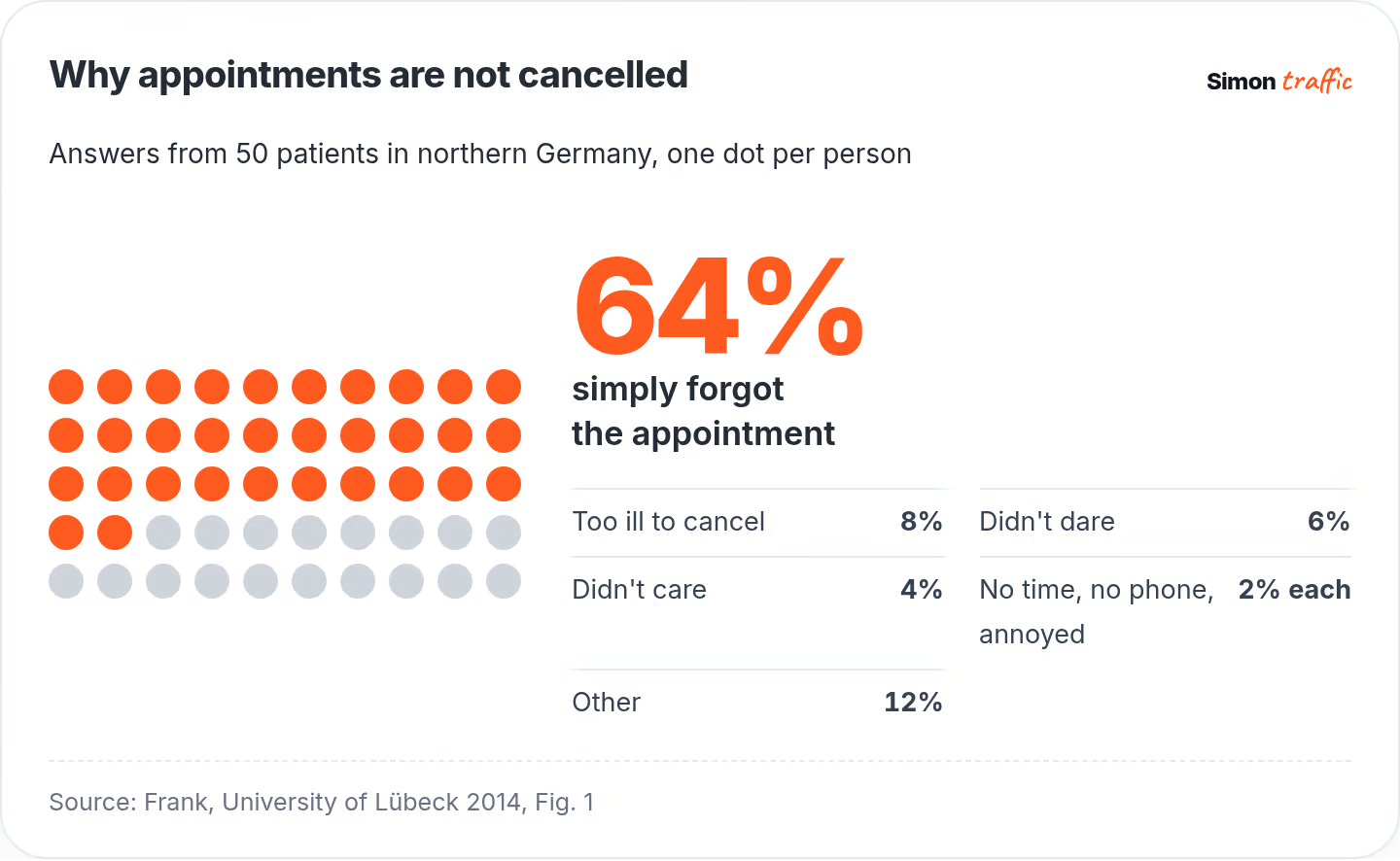
International reviews also count forgetting among the most common reasons, alongside work, family and getting there.2 Two more patterns come up again and again. The longer the gap between booking and appointment, the more often it is missed.1 And people who are afraid of the appointment, don't feel taken seriously or don't know how to cancel are more likely to stay away.4
That's good news. You can do something about forgetting, long lead times and awkward cancelling without chasing your clients by phone.
9 ways to reduce no-shows
The following ways target exactly the reasons that studies have found. The first five work against forgetting, the rest against long lead times, hurdles and a lack of commitment.
1Online appointment booking: let clients book themselves
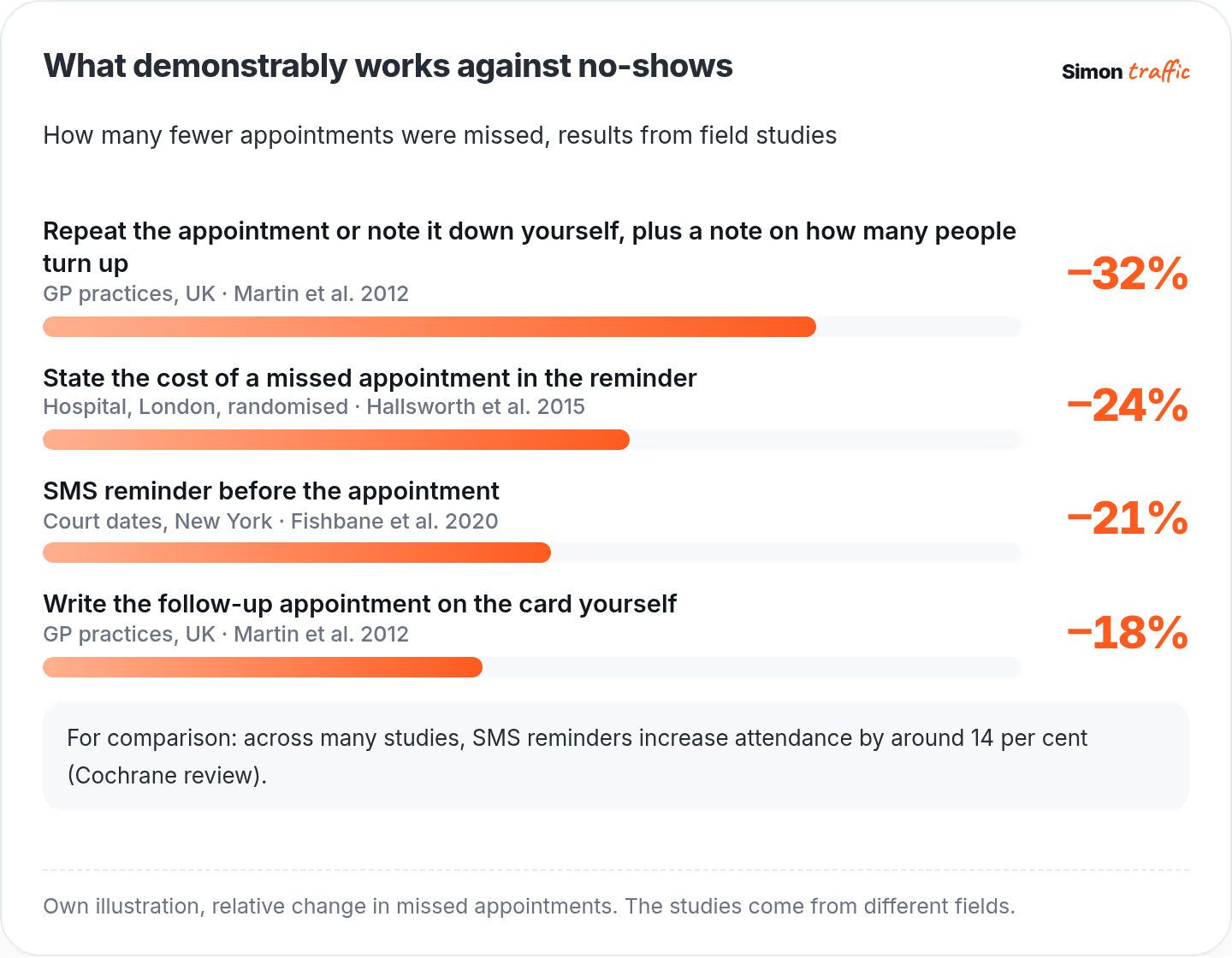
People who choose the day and time themselves commit more actively than someone who is assigned an appointment. In British GP practices, missed appointments fell by 18 per cent after patients wrote their follow-up appointment on the appointment card themselves.5 On top of that, the email ping-pong to find a suitable time disappears, and no proposed time is already taken by the time they reply.
2Instant confirmation, with a calendar entry
A confirmation straight after booking, with a file for the calendar, makes sure the appointment sits where the client will look. In a study of more than 3,000 employees, more people got vaccinated when they noted down the date and time themselves. The date alone had no measurable effect.6
3Automatic appointment reminders by SMS and email
Automatic reminders are the best-evidenced way to reduce no-shows. A Cochrane review found that text messages increase attendance by around 14 per cent compared with no reminder, and are just as effective as a phone call but cheaper.7 That this isn't limited to doctors is shown by a study in Science: SMS reminders cut missed court dates in New York by 21 per cent.8
Of all the reminders, the SMS does the most for me. It lands straight on the phone and is usually read immediately, whereas an email easily gets lost among newsletters. The day before is exactly when someone realises something has come up, and can still rebook in time. Keep it short: who is writing, when the appointment is and how to rebook. That's all it needs.
For reminders by SMS or WhatsApp you need your clients' consent. It's best to get it right when they book. For which SMS providers are suitable, see my comparison Appointment reminders by SMS: the 6 best-known providers.
An appointment reminder via WhatsApp sounds obvious but is more involved. It can only be automated through Meta's WhatsApp Business Platform: with a business account, message templates approved by Meta and a cost per message. In the free WhatsApp Business app you send reminders by hand. An SMS, by contrast, arrives on any phone, with no app and no approval.
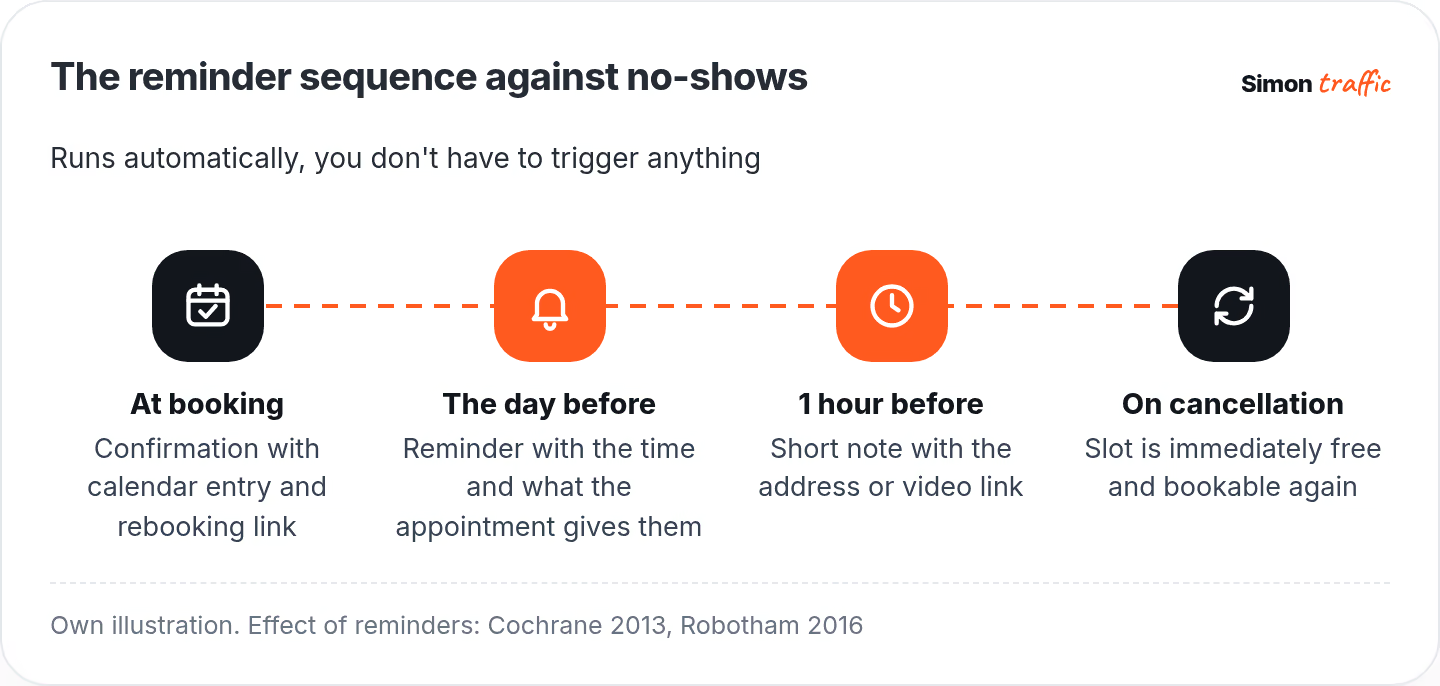
The reminder sequence against no-shows
Runs automatically, you don't have to trigger anything
- At bookingConfirmation with calendar entry and rebooking link
- The day beforeReminder with the time and what the appointment gives them
- 1 hour beforeShort note with the address or video link
- On cancellationSlot is immediately free and bookable again
4Word the appointment reminder: name the consequence
An appointment reminder works better when it says specifically what a no-show means. In two randomised studies in London, the no-show rate fell from 11.1 to 8.4 per cent when the SMS stated the cost of a missed appointment. General wording had a weaker effect.10 Here is a template for your reminder the day before:
Hi Anna, it's Simon. I just wanted to make sure you have the link to our first call tomorrow at 10:00 am: [link to video room]. Do let me know briefly that all is fine.
So we can make good use of the time: think beforehand about which question matters most to you.
If something comes up, that's no problem: just rebook or cancel here. Then someone else can use the slot.
Subject: Reminder of our appointment tomorrow at 10:00 am
Dear Ms Berger, I'm looking forward to our conversation tomorrow, Tuesday, at 10:00 am. You can reach the video room via this link: [link].
Should something come up, you can reschedule or cancel the appointment here up to 24 hours beforehand: [link]. If you cancel later or don't turn up, I will charge the agreed no-show fee.
Kind regards, Simon Gütter
Hi Anna, it's Simon: our appointment is tomorrow at 10:00 am. Rebook up to 24 hrs before, after that a no-show fee applies: [link]
Practical tip: Word the reminder so that it doesn't offer a way out: not “Does tomorrow still work?” but “I wanted to make sure you have the link”. Put your name right at the start so the client can place the message. And ask for a short reply, because someone who confirms commits a second time. Some people go further and release the slot if no confirmation comes. That filters hard and also costs you serious clients.
What demonstrably works against no-shows
How many fewer appointments were missed, results from field studies
For comparison: across many studies, SMS reminders increase attendance by around 14 per cent (Cochrane review).
5Make cancelling and rebooking easy
A rebooking link in every email turns a no-show into a cancellation made in good time. In the Lübeck survey, 6 per cent hadn't dared to cancel and 2 per cent had no phone to hand.3 Both hurdles disappear when one click is enough. Thank people for every cancellation. It shows that cancelling is explicitly welcome, and the slot can go to someone else.
Practical tip: Say explicitly that cancelling is fine. Many clients would rather simply stay away than risk a reproach when cancelling. Also offer more than one way, because someone who can't get through by phone often doesn't cancel at all. A link, an email or a message closes that gap.
6Limit the lead time
The further in the future an appointment is, the more likely it is to be forgotten. A long lead time is among the most frequently documented reasons for no-shows.1 So only allow bookings a few weeks ahead, and also set a minimum notice period so nobody books five minutes beforehand while you're already sitting in the next appointment.
7Set expectations with questions in advance
Clients are more likely to come when they know what to expect in the appointment. Some no-shows stem from uncertainty or fear of the appointment.4 On the booking page, describe in two sentences what happens in the conversation, and ask two or three questions in advance. That also saves you the first few minutes of the appointment, because you start prepared.
Practical tip: Put the questions before the calendar rather than after it. Fewer people will book, but those who do are more likely to turn up. Whether that's worth it depends on what matters more to you: lots of bookings or reliable appointments.
8Reassign freed-up slots immediately
A cancellation is only a gain if someone else can use the slot. If a cancelled appointment is bookable online again straight away, it often fills itself. A waiting list helps too: whoever is waiting for an earlier slot gets notified of a cancellation and can move up.
9State the no-show fee openly
A no-show fee works above all when it is visible before the appointment: at booking, in the confirmation and in every reminder. Scientifically, the effect of fees has hardly been studied. A review of 61 studies found only two on money: a reward for turning up helped, while a penalty fee showed no clear effect.11 Practice sees it differently.
Hardly anything makes appointments as binding as an openly stated no-show fee. Once it's on the table, a casual appointment becomes an arrangement with weight: people who can't make it get in touch beforehand instead of simply staying away. What matters is that the rule comes early and in a friendly way, so on the booking page first, then in the confirmation and once more in the reminder. It isn't about collecting money but about showing that the reserved time has a value. Anyone who cancels or rebooks in time pays nothing.
A sentence like “If you cancel less than 24 hours beforehand, I charge a no-show fee” is enough for that.
Practical tip: Put the no-show rule on your website, in the confirmation and in every reminder, and then actually apply it. A rule that never applies isn't taken seriously by anyone.
For paid appointments, paying directly at booking is an alternative: the appointment is then already paid for, and you don't have to chase invoices.
No-show fee: what the law says (Germany)
In Germany you can generally charge a no-show fee if you were available for a firmly agreed, paid appointment and the client doesn't keep it without cancelling in time. The basis is default of acceptance under § 615 of the German Civil Code (BGB).12 Whether the claim exists in a particular case depends on several conditions, though.
- Default of acceptance: Anyone who owes services and is available can demand the agreed fee if the client doesn't accept them. The client must have credited against it whatever they save as a result or earn elsewhere in the meantime.12
- Slot not used otherwise: In 2022 the German Federal Court of Justice (Bundesgerichtshof) confirmed that § 615 BGB also applies to treatment appointments. One condition is, among other things, that the slot was not used for other clients. Whether an appointment was firmly fixed depends on the circumstances, for example how appointments are organised.13
- Agree it clearly beforehand: Without an explicit agreement, German courts sometimes reject no-show fees. So state the fee and the cancellation deadline before booking and have them confirmed.14
- Flat fee in general terms and conditions (AGB): A flat-rate fee must not be higher than the loss that typically arises, and the client must be expressly allowed to prove that no loss or a lower loss occurred (§ 309 no. 5 BGB).15
- Free initial call: § 615 BGB presupposes an agreed fee. For a free initial or introductory call there is none from which a no-show fee could arise. Only an expressly agreed no-show fee is then possible, and in general terms and conditions with consumers it is only effective to a limited extent (§ 309 no. 5 and no. 6 BGB).15 For free appointments, reminders and easy rebooking usually work better than a fee.
Fewer no-shows with the Simon Traffic appointment booking
The appointment booking puts most of these ways into practice automatically: clients book themselves, get an immediate confirmation with a calendar entry, are reminded by email and, if you wish, by SMS, and can rebook or cancel via a link. You set lead time, buffer and questions in advance for each appointment type, with a video room and payment via Stripe if you wish. It runs as a WordPress plugin or on your own server. The software is free and has no subscription: your only running costs are for your web space and, if you use SMS, for the SMS at seven.io.
- Reminders by email and SMS
- Rebooking via link
- WordPress plugin
- Free, no subscription
- Data stays with you
How to get started today
To get fewer no-shows, three steps are enough, and you can do them in one afternoon.
- Create a booking page: for example “First call, 30 minutes”, with two questions in advance, a buffer and at most four weeks' lead time.
- Switch on reminders: confirmation straight away, a reminder the day before and one an hour before, each with a rebooking link.
- Share the link: on your website, in your email signature and with every appointment request, instead of agreeing times by email.
With the Simon Traffic appointment booking this works as a WordPress plugin or on your own server. After free registration you download the plugin, server package and instructions from the library.
Conclusion: no-shows are mostly forgotten appointments
You can reduce most no-shows, because they come from forgetting and not from intent. Automatic reminders with a calendar entry, an easy way to rebook and a short lead time tackle exactly that. I see the biggest difference with two things: the SMS the day before and a no-show fee that is clearly stated before booking. If clients also book themselves, you additionally save the back and forth over every single appointment.
Frequently asked questions about no-shows
What does no-show mean?
A no-show is a booked appointment that the client neither attends nor cancels beforehand. The time you set aside, and often already prepared for, stays empty.
What is a normal no-show rate?
Reliable figures mainly come from healthcare. A review of 105 studies puts the average there at around 23 per cent, and in GP practices in five countries the average rate was 15.2 per cent. For consulting and services there are no comparable studies.
How do I calculate the no-show rate?
Divide the number of missed appointments by all booked appointments and multiply by 100. With 6 no-shows out of 40 appointments a month, the no-show rate is 15 per cent.
Why do clients forget their appointments?
Usually simply because the appointment gets lost in everyday life. In a survey by the University of Lübeck (Germany), 64 per cent of patients who had not cancelled gave forgetting as the reason. Other factors are a long lead time between booking and appointment, hurdles to cancelling and the feeling that the appointment is not important.
How do I word an appointment reminder?
Short and specific: name, date and time, place or video link, what the appointment gives them, and a link to rebook. One sentence on the consequence of a no-show helps, for example: If you can't make it, just cancel briefly, then someone else gets the slot.
Is a no-show fee legal?
Under German law, generally yes, if you were available for a firmly agreed appointment and the client did not cancel in time. The basis is default of acceptance under § 615 of the German Civil Code (BGB). What matters is a clear agreement before booking, a reasonable amount and that the slot was not used otherwise. A flat fee in general terms and conditions (AGB) must not exceed the typical loss. For a free initial call, § 615 BGB generally does not apply, because no fee has been agreed. Have your rule checked legally.
SMS, WhatsApp or email: which should I use for reminders?
SMS reminders are the best researched, and in my experience they work most reliably, too. An email with all the details and the rebooking link is a good addition. An appointment reminder via WhatsApp can only be automated through the WhatsApp Business Platform, with approved templates and a cost per message. For SMS and WhatsApp you need your clients' consent beforehand.
How can clients cancel or reschedule themselves?
Via a link in the confirmation and in every reminder. The client picks a new free slot or cancels without calling. The freed-up slot can be booked again immediately.
Is there a free booking tool with reminders?
Yes. Well-known providers such as Calendly, Cal.com or meetergo have free starter plans; which reminders and features are included differs by plan. If you don't want a subscription and want the booking data to stay on your own server, the Simon Traffic appointment booking is an alternative: it runs as a WordPress plugin or on your own web space and sends confirmation and reminders by email and, if you wish, by SMS via seven.io, each with a rebooking link.
Sources
- Dantas, L. F., Fleck, J. L., Cyrino Oliveira, F. L., Hamacher, S. (2018): No-shows in appointment scheduling – a systematic literature review. Health Policy 122(4), 412–421. doi.org/10.1016/j.healthpol.2018.02.002
- Parsons, J., Bryce, C., Atherton, H. (2021): Which patients miss appointments with general practice and the reasons why: a systematic review. British Journal of General Practice 71(707), e406–e412. pmc.ncbi.nlm.nih.gov/articles/PMC8103926
- Frank, W. F. A. (2014): No-Shows in ambulanten Einrichtungen des norddeutschen Gesundheitswesens. Dissertation, Universität zu Lübeck. epub.uni-luebeck.de/handle/zhb_hl/1727
- Lacy, N. L., Paulman, A., Reuter, M. D., Lovejoy, B. (2004): Why we don’t come: patient perceptions on no-shows. Annals of Family Medicine 2(6), 541–545. pmc.ncbi.nlm.nih.gov/articles/PMC1466756
- Martin, S. J., Bassi, S., Dunbar-Rees, R. (2012): Commitments, norms and custard creams – a social influence approach to reducing did not attends (DNAs). Journal of the Royal Society of Medicine 105(3), 101–104. pmc.ncbi.nlm.nih.gov/articles/PMC3308641
- Milkman, K. L., Beshears, J., Choi, J. J., Laibson, D., Madrian, B. C. (2011): Using implementation intentions prompts to enhance influenza vaccination rates. PNAS 108(26), 10415–10420. pmc.ncbi.nlm.nih.gov/articles/PMC3127912
- Gurol-Urganci, I., de Jongh, T., Vodopivec-Jamsek, V., Atun, R., Car, J. (2013): Mobile phone messaging reminders for attendance at healthcare appointments. Cochrane Database of Systematic Reviews, CD007458. cochrane.org/CD007458
- Fishbane, A., Ouss, A., Shah, A. K. (2020): Behavioral nudges reduce failure to appear for court. Science 370, eabb6591. doi.org/10.1126/science.abb6591
- Robotham, D., Satkunanathan, S., Reynolds, J., Stahl, D., Wykes, T. (2016): Using digital notifications to improve attendance in clinic: systematic review and meta-analysis. BMJ Open 6, e012116. pmc.ncbi.nlm.nih.gov/articles/PMC5093388
- Hallsworth, M., Berry, D., Sanders, M., Sallis, A., King, D. et al. (2015): Stating appointment costs in SMS reminders reduces missed hospital appointments: findings from two randomised controlled trials. PLOS ONE 10(9), e0137306. doi.org/10.1371/journal.pone.0137306
- Werner, K., Alsuhaibani, S. A., Alsukait, R. F. et al. (2023): Behavioural economic interventions to reduce health care appointment non-attendance: a systematic review and meta-analysis. BMC Health Services Research 23, 1136. pmc.ncbi.nlm.nih.gov/articles/PMC10594857
- § 615 BGB (German Civil Code), Vergütung bei Annahmeverzug und bei Betriebsrisiko. gesetze-im-internet.de/bgb/__615.html
- Bundesgerichtshof (German Federal Court of Justice), judgment of 12.05.2022, III ZR 78/21. Summary: Bergmann und Partner, Ausfallhonorar bei Nichteinhaltung eines Termins. bergmannpartner.com
- IWW Institut, Forderungsmanagement professionell: Neues zu Ausfallhonoraren und Strafgebühren von Ärzten, wenn der Patient nicht erscheint (including AG Diepholz, 2 C 92/11). iww.de
- § 309 no. 5 and no. 6 BGB (German Civil Code), Pauschalierung von Schadensersatzansprüchen und Vertragsstrafe. gesetze-im-internet.de/bgb/__309.html
The practical tips are rules of thumb from my own research, not studies.
Simon Gütter is a marketing expert and has worked for years at the intersection of marketing, sales and automation. He finds the places where companies lose time and clients, and builds processes that run on their own: from appointment booking to reporting. More about Simon