
DeepSeek Harness and REA: Open-Source AI Agent, Costs in Euros, Privacy and Law
Can you use DeepSeek Harness and REA to take other people's software apart and build your own tools for your business from it? Technically yes, but only with care. DeepSeek Harness is an open source agent app from DeepSeek under the MIT licence, which, according to the safety notice in the repository, counts as a developer preview and has not undergone a security review.1,2,7 REA (Reverse Engineer Anything) gives an AI agent tools for examining programs and delivers results with evidence and limitations.8 If the model runs via the DeepSeek API, your inputs go to DeepSeek, and the privacy policy names the People's Republic of China as the storage location for the services.15 Here you can see how to connect REA to Harness, what that costs in euros, what businesses should clarify on legal and privacy matters, and how to check a result before you trust it.
DeepSeek Harness is an open agent app in which everything runs through plugins, and REA is a toolkit with which a DeepSeek agent examines programs and backs up its findings with evidence. REA delivers the findings together with evidence; according to the README, the agent uses them to explain the behaviour or to write and test an implementation.8 For the task, I recommend a template in four parts (Study, Evidence, Rebuild, Polish). For businesses, I advise: only in a disposable environment (the manufacturer recommends a disposable VM or a container), only with software that you own or are allowed to examine (such as open source projects whose licence permits the reuse you want), and without customer data as long as third-country transfer to China, training on API inputs and a data processing agreement for the DeepSeek API have not been clarified.2,15,16 In my assessment, the model costs little (DeepSeek V4.1 Flash: input without a cache hit €0.137 per million tokens off-peak), and the bigger hurdles are privacy and licensing.12,14
The key facts in numbers
- 284,031 and 469,229 GitHub stars: That is how many stars DeepSeek Harness and REA had on 19/11/2026. Both are under the MIT licence. Stars show popularity, not security.5,7,11
- 0.2.2-rc.5 and 6.9.0: Harness is only available as a pre-release (latest version rc.5 from 18/11/2026), while REA is at version 6.9.0 from 12/11/2026.5,6,11
- $0.15 or €0.137 per million tokens: That is the cost of input without a cache hit with DeepSeek V4.1 Flash off-peak (peak: $0.30 or €0.274), and output costs $0.60 or €0.547 (peak: $1.20 or €1.094). ECB rate of 18/11/2026: €1 = $1.0968.12,14
- 1 million tokens of context: The
deepseek-flashmodel handles 1 million tokens of context and up to 384K tokens of output.12 - 24.9.0 and 24.22.1: Harness requires Node.js from version 24.9.0, and REA, according to its docs, 22.x from 22.23.4, 24.x from 24.22.1 or 26.12.1 and newer.6,8,11
- 30/01/2025 and 27/06/2025: On 30/01/2025 the Italian data protection authority Garante restricted the processing of data of people in Italy, and on 27/06/2025 the Berlin data protection commissioner reported the DeepSeek apps to Apple and Google.19,17
What is DeepSeek Harness?
DeepSeek Harness is an open source agent developed by DeepSeek AI with an “Everything is a Plugin” architecture. You start it from the command line with the command dsh (the DeepSeek CLI, so to speak); the subcommand web starts the web interface. The README calls its status “developer preview” and warns: “THERE WILL BE COMPATIBILITY-BREAKING CHANGES”. All versions on npm carry suffixes such as rc or alpha, and the latest is 0.2.2-rc.5 (GitHub release of 18/11/2026).1,5,6 The repository was created on 13/08/2026.5
The safety notice (SAFETY.md) is clear: Harness is “experimental developer-preview software”, has not undergone a security review and must not be treated as safe or production-ready. The program can run code and commands generated by the model, load third-party plugins and access the network, processes, credentials and files that you give it access to. Sandbox, confirmation prompts and permissions reduce the risk but do not guarantee isolation. The recommendations are as few permissions as necessary, a disposable VM or a container, backups of all reachable files, no sensitive credentials and data (unless you accept the risk), and a review of plugins and commands before they are run.2
According to the docs, the agent can read and change files in the workspace, run commands, delegate work and keep a plan; before actions that need approval under the active permission policy, the interface asks you first.3
Harness is not tied to DeepSeek models. The docs name providers such as anthropic, openai and moonshotai as well as a “Custom model API” option for gateways, your own servers and other providers, with four possible protocols.4 The DeepSeek API docs list Harness under “Agent Integrations”.24 As an open source AI agent, Harness is therefore a construction kit, not a finished product.
What is REA (Reverse Engineer Anything) and what can it do?
REA is a toolkit that, via MCP (an interface through which agents call tools), lets an agent examine programs: native programs, JavaScript and Electron apps, .NET assemblies and websites.8 According to the README, the analysis runs locally, and the results contain “the evidence and limitations behind each conclusion”, in other words the evidence and limits of each conclusion.8 That is AI reverse engineering: REA delivers the findings with evidence, and the agent uses them to explain how a function works and to write and test its own implementation.8
Pay attention to the name: the npm package is called rea-agents (command rea). The README names the repository morluto/rea, the website rea.tools and the npm package rea-agents as the official sources; a similar repository name or a copied README does not prove that a download is official.8,11 The current version is 6.9.0 from 12/11/2026, and the previous one, 6.8.0, was released on 25/10/2026.11
The README lists many more target formats than the four mentioned; the table shows a selection.8
| Target | What REA delivers | Requirement |
|---|---|---|
| JavaScript and Electron apps | Modules, imports, source maps, routes, IPC (communication between app parts), native add-ons | Node.js and npm; on Linux a procps-style ps |
| .NET assemblies | Metadata, CIL instructions, declared native dependencies, comparison of builds | none (static only) |
| Websites | Page structure, scripts, network observations, requested screenshots | a Chrome-family browser |
| Native programs | Pseudocode, assembly, strings, symbols, calls, references | Hopper, Ghidra, IDA or Kuna |
| Android APKs | Manifest, classes, decompiled methods, references | JADX (headless) and a full JDK |
| Firmware | Regions, extraction results, handovers to native analysis | Binwalk or Unblob on Linux |
Source: REA README, section “What you can analyze”, retrieved 19/11/2026.8
Important in practice: static analysis of JavaScript and .NET reads the supplied files without starting the application. Runtime recording, by contrast, runs the chosen target or interacts with it, and does so with your user rights.8
What REA cannot do
REA takes things apart and provides evidence; your agent writes the rebuild. These are the limits:
- Deep analysis of native programs needs an analysis engine. Hopper, Ghidra, IDA or Kuna must be present; only Hopper can install the setup after you agree. You must obtain and be allowed to use commercial tools such as IDA Pro and Hopper lawfully, as REA grants no licence for them; for Hopper, the installation docs mention a demo, and a paid licence is optional there. For static JavaScript, on the other hand, Node.js is enough.8,26
- The evidence file can become huge. According to the docs, the full evidence of a real application can be “hundreds of megabytes” in size; the docs recommend saving it in a file and having summaries or individual modules displayed.10
- The DeepSeek API is not documented as live-tested in the REA docs. REA optionally checks the Harness integration with a local model; the docs describe compatibility with the real DeepSeek API as “unverified”.9
How do you set up DeepSeek Harness with REA? Step by step
At its core, the integration consists of two commands (start Harness, register REA), but the preparation decides how safe it is. The steps are based on the READMEs and documentation of both projects.
- Create a disposable environment. Use a virtual machine or a container with no access to customer data, passwords and production systems, and back up everything the agent can reach.2
- Check Node.js. Harness needs Node.js from 24.9.0, REA 22.x from 22.23.4, 24.x from 24.22.1 or 26.12.1 and newer.6,8,11 For both together, that means Node 24 from 24.22.1 or Node 26 from 26.12.1; Node 22 is not enough for Harness.
- Start Harness.
npx @deepseek-ai/dsh webstarts the interface athttp://127.0.0.1:3080. With--no-openno browser opens.1 Run the command in the folder that is to become your workspace, becausedshuses the start folder as the default storage location.3 - Enter the model. In Settings under Models, save the DeepSeek API key. The model name of the API is
deepseek-flash.3,12 The key is stored in the file$DSH_HOME/.credentials.yaml.4 According to the safety notice, bugs can expose credentials; so top up your account with only a small amount, so that a bug doesn't become expensive.2 - Register REA.
npx rea-agents setup --client dshadds REA to the filecordis.patch.ymlin the Harness directory, by default~/.dsh/cordis.patch.yml. Setup shows the planned changes, you have to agree, and it makes backups of the existing configuration. Run it from a trusted folder outside the target project. The client identifierdshhas existed since rea-agents 6.5.0.8,9,26 - Check the connection.
npx rea-agents doctor --client dshchecks the same entry. Afternpm install --global rea-agents, the short formrea doctor --client dshis enough.8,9 - Restart Harness. The tools are then available under the name
mcp__rea__<tool_name>. Optionally, you install the working guide for the agent: firstnpx rea-agents setup --skill --dry-run(shows the target), thennpx rea-agents setup --skill --yes(with a global installation, use the short formrea setup --skill ...in each case). Harness can load the skillreverse-engineer-anythingfrom it.9 - Choose a workspace. In the interface, click Choose workspace, then select the folder in which you started
dsh; without a workspace the input field stays locked.3 Create a folder in it for the project to be examined (for examplesource) and one for the results. Make a copy of the source folder and, where possible, keep it read-only. Write protection is only a hurdle: according to the safety notice, sandbox and permissions reduce the risk but do not guarantee isolation.2 - Paste the task. Use the template from the section “The four-part prompt” further down. Only loosen the permissions once you understand exactly which commands the agent runs.3
- Check the result. Open the evidence file first, then the result, and work through the checklist further down.
Because the Harness README announces changes that break compatibility, individual steps may differ in new releases.1
How does REA back up its results? The evidence principle
In my assessment, the value of REA lies less in the rebuild than in the fact that statements come with a location and a limitation. The REA docs describe an evidence object that contains, among other things, subject, provider, authority, confidence, locations, links, limitations and coverage. Coverage states, for example, how many entries were checked and whether only one page of a larger result is available.10
The file evidence.md and a section such as “What could not be proven”, on the other hand, are not a fixed feature of REA. They come about because, in the task, you tell the agent to write its findings into this file and to name gaps. REA supplies the evidence and limitations as raw material, and the agent summarises them.8,10 You still have to check it yourself.
What does a good task look like? The four-part prompt
A good task separates understanding from building and demands the evidence before the building. I recommend four parts for this: Study, Evidence, Rebuild, Polish.
Part 1 asks clear questions, part 2 demands evidence and names gaps, part 3 instructs the agent to use only ideas and not copy any code, and part 4 has the agent check its own result. That does not replace your own check: look at the result for adoptions from the source code that are too close.
As a copyable template (you replace the placeholders in square brackets):
1 Study: Use REA to examine how [function] works in the project in the folder
"source". Answer: [two to three specific questions, for example which files
are involved and how data is stored].
2 Evidence: Write all findings to evidence.md. For every statement, give the file
and function. Write a separate section "What could not be proven".
3 Rebuild: Build [result] for [target group] from it. Use the ideas and
processes, write the code yourself and do not copy any source code from "source".
4 Polish: [look, language, format]. At the end, check yourself whether all
controls work, and list open points.
Limits: Only read "source". Only write to the folder "results". No
credentials, no customer data, delete nothing.
The first time, don't give the agent a whole large project, just the part with the function you want. That keeps the evidence file small and the result checkable.
What can agencies and SMEs use the agent for?
With DeepSeek Harness and REA, agencies and SMEs can derive small tools of their own from open projects, such as a reporting agent, a landing page builder or a question radar. The three examples are ideas without a practical test of my own and show what a task following the four-part pattern can look like. The table only reproduces what the READMEs of the study objects say about purpose and licence.22 Whether a project really contains the pattern you want only becomes clear from the evidence file.
| Idea for the business | Possible study object | Purpose according to README | Licence, stars on 19/11/2026 |
|---|---|---|---|
| Reporting agent: weekly report for clients from exported metrics | smolagents | Library for running agents in a few lines of code; the CodeAgent writes its actions as code | Apache-2.0, 30,444 |
| Landing page builder: offer pages made of blocks such as benefits, process, questions, appointment button | Puck | Visual open source editor for React; drag-and-drop with your own components | MIT, 13,738 |
| Question radar: list of open questions in a forum with a draft reply | Discourse | Open source platform for discussions with topics, chat and plugins | GPL (version 2 or later), 48,097 |
You practise the reporting agent with made-up data that has no personal reference, and you test the landing page builder in a staging area before using it. For the question radar there are two warnings: the GPL-2.0 requires that a work that contains code from the program or is derived from it, and that you distribute, be placed as a whole under the same licence (clause 2 b).25 So don't take over any source code before you have checked the licence terms. And you shouldn't send forum posts by real people to the DeepSeek API without clarified privacy (see the privacy section). Never send replies automatically.
What does DeepSeek Harness cost with V4.1 Flash in euros?
Harness and REA themselves are free to use under the MIT licence; costs arise from using the model via the DeepSeek API.7,11,12 As the model, the API docs name deepseek-flash in the version DeepSeek-V4.1-Flash-1017 with 1 million tokens of context, up to 384K tokens of output, image understanding, tool calls and JSON output.12 The V4.1 Flash version was released on 10/09/2026 and the 1017 update on 17/10/2026, with the call and prices remaining unchanged according to the changelog.13
Prices per 1 million tokens (as of 19/11/2026, converted with the ECB reference rate of 18/11/2026: €1 = $1.0968, rounded):12,14
| Item (per 1m tokens) | Off-peak in $ | Off-peak in € | Peak in $ | Peak in € |
|---|---|---|---|---|
| Input, cache hit | 0.003 | 0.0027 | 0.006 | 0.0055 |
| Input, cache miss | 0.15 | 0.137 | 0.30 | 0.274 |
| Output | 0.60 | 0.547 | 1.20 | 1.094 |
Put simply, a cache hit means that input that has already been processed is reused; the pricing page does not explain the term. According to the docs, peak hours are 01:00 to 04:00 and 06:00 to 10:00 UTC, Monday to Friday, excluding Chinese public holidays. All other times cost half, including weekends and Chinese public holidays.12 In German time, this corresponds (own conversion) to 02:00 to 05:00 and 07:00 to 11:00 in winter time (UTC+1, since 25/10/2026), and to 03:00 to 06:00 and 08:00 to 12:00 in summer time (UTC+2).
Worked example with assumed quantities, not a measurement: One run uses 4m input tokens with a cache hit, 1m without a cache hit and 0.3m output tokens. Off-peak that costs 4 × 0.003 + 1 × 0.15 + 0.3 × 0.60 = $0.342 (about €0.31), and at peak 4 × 0.006 + 1 × 0.30 + 0.3 × 1.20 = $0.684 (about €0.62). You can see the real usage in your account.
On web search: since 18/11/2026, 12:00 Beijing time, server-side search and fetch calls triggered during the model call are no longer charged. The results returned do count as tokens, though.12 DeepSeek reserves the right to change prices.12
Privacy and law for SMEs: What do you need to clarify before using it?
Don't give the DeepSeek API any customer data as long as third-country transfer to China, training on API data and data processing have not been clarified. This is not legal advice but the state of the sources on 19/11/2026. For binding statements, ask a legal adviser or your data protection officers.
Privacy: What the sources say
The privacy policy names China as the storage location; whether API inputs are used for training and whether there is a data processing agreement remains open in the pages checked.
| Question | What the sources say | Status |
|---|---|---|
| Where does DeepSeek store data? | “we directly collect, process and store your Personal Data in People's Republic of China” (privacy policy, as of 10/02/2026)15 | documented |
| Controller? | Hangzhou DeepSeek Artificial Intelligence Co., Ltd., based in China; EU representative according to the policy: Prighter Group15 | documented |
| Training on data? | The policy names using data “to train and improve our technology” as a purpose; among the data subject rights there is an opt-out from use for training; you shouldn't enter sensitive data15 | documented (for apps, websites and services) |
| Does this also apply to the API? | According to the policy, the rules for end-user data in applications that developers build with the Open Platform are not covered; there, the developer is the controller. For the account holder's data, the Open Platform terms refer to the privacy policy15,16 | documented |
| Training on API inputs? | The Open Platform terms are a “Specific Agreement” to the general terms of use. Their clause 4.3 (as of 27/03/2026) allows inputs and outputs to be used “to a minimal extent” after encryption and de-identification to improve the services; opt-out via “Improve the model for everyone”. The Open Platform terms do not regulate this themselves, and the pages do not say whether the setting applies to API inputs16,23 | not clarified |
| Data processing agreement (DPA)? | Not mentioned in the pages checked | not clarified |
| Rights in inputs and outputs? | You keep the rights in your inputs, and rights in outputs are assigned to you, in each case “if any”, i.e. insofar as any exist, and on condition that you comply with the law and the terms of use (clause 4.2, Open Platform Terms, in force from 29/04/2026)16 | documented |
| Authorities in Germany? | Berlin data protection commissioner, 27/06/2025: sees a breach of Art. 46(1) GDPR and reported the apps to Apple and Google as unlawful content; according to the authority, the EU has not adopted an adequacy decision for China17,18 | documented |
| Authorities in Italy? | Garante, 30/01/2025: restriction of the processing of data of people in Italy; as one of several violations, the decision names storage in China according to the privacy policy19 | documented |
For context: the Berlin authority had asked DeepSeek on 06/05/2025 to remove the apps from the German app stores, to stop the transfer to China or to meet the requirements for a lawful transfer, and reported the apps to the app stores on 27/06/2025.17 How the store operators decided is not apparent from the press release and the annual report extract. Both measures concern DeepSeek's service and apps, not expressly the API in an open source agent. What that means for your API use, you have to clarify yourself or have clarified. What a data processing agreement is and when you need one is explained in the glossary.
My conclusion: test Harness with public material or made-up data. Don't put customer lists, contracts, credentials or internal documents in the workspace. Your agent also receives the locally generated tool results from REA, such as pseudocode; according to the README, its model provider has its own data policy.8 For commercial analysis tools such as Hopper, the README mentions manufacturer terms for trial versions and demos, including on passing on outputs; check them before results go to a model provider.8
Alternative: open weights, EU hosts or your own server
The model itself is open: on Hugging Face, DeepSeek-V4.1-Flash and DeepSeek-V4.1-Flash-1017 are listed with the licence tag MIT, without access restrictions.20 You could then use the model with another provider or host it yourself; you check the licence terms of the model files yourself beforehand. Harness supports other providers and your own servers for this via “Custom model API”.4 Which providers in the EU host the model and what privacy they offer has not been checked here; for that you need the documents of the respective provider. According to Hugging Face metadata, the model has about 763 billion parameters.20 For an ordinary office computer, that is probably far too large. Local agents with smaller models are shown in the article on Google Antigravity locally with Ollama, and another Chinese model in the article on Qwen 4 Max.
Reverse engineering and copyright: §§ 69a ff. German Copyright Act (UrhG)
Ideas and principles of a program are not protected. For copying, adapting or distributing someone else's code, on the other hand, you generally need the rights holder's consent. What is permitted without consent when examining a program is regulated mainly by § 69d and § 69e UrhG (the German Copyright Act) for computer programs. The table summarises the important provisions.21 REA itself names lawful research, teaching, interoperability, software preservation and the analysis of software that you own or are allowed to examine as its intended uses.8
| Provision | What the statute says | What that means for you |
|---|---|---|
| § 69a(2) | Protection applies to all forms of expression of a program. Ideas and principles that underlie any element of a computer program, including the ideas and principles underlying its interfaces, are not protected | Understanding a principle is something different from copying code |
| § 69c nos. 1 to 3 | The rights holder has the exclusive right to reproduction, translation, adaptation and rearrangement, and distribution | Copying, reworking or passing on code needs permission, as a rule a licence |
| § 69d(3) | Whoever uses a program lawfully may observe, study or test its functioning in order to determine the underlying ideas and principles, if this is done through acts they are entitled to perform (loading, displaying, running, transmitting, storing) | Observing, studying and testing while loading, displaying, running, transmitting or storing a program that you use lawfully is permitted without consent in order to determine the underlying ideas; the wording of this provision does not cover decompiling or copying code (decompilation is governed by § 69e) |
| § 69e | Reproduction of the code or translation of the code form is permitted without consent if it is indispensable to establish the interoperability of an independently created program, a person entitled to do so (such as the licensee) acts, the information is not readily accessible and the acts are limited to the necessary parts. Among other things, the information obtained must not be used for the development, production or marketing of a program with a substantially similar form of expression | A rebuild with a substantially similar form of expression is expressly not covered by this exception |
Source: German Copyright Act (UrhG) §§ 69a, 69c, 69d, 69e, gesetze-im-internet.de, retrieved 19/11/2026. The table summarises the wording and does not replace it.21
Licences: What do MIT, GPL-2.0 and “closed” mean?
For open source projects, the licence decides what you may do with code. The table shows the licences of the projects in this article.11,22
| Project | Licence | What that means for you |
|---|---|---|
| DeepSeek Harness, REA | MIT | According to the licence text, you may use, copy, modify, publish, distribute, sublicense and sell the software; the copyright and licence notice must remain in all copies; the software is provided without warranty7,11 |
| Puck | MIT | According to the README, the MIT licence permits internal and commercial use22 |
| smolagents | Apache-2.0 | Read the licence terms before you take over code22 |
| Discourse | GPL (version 2 or later) | The GPL-2.0 requires that a distributed work that contains code from the program or is derived from it be placed as a whole under the same licence. Clarify this before any adoption22,25 |
| Closed, commercial software | no open licence | Never take apart or rebuild without checking: first read the licence agreement and terms of use, and if in doubt get legal advice |
When rebuilding a function in your own code, the difference between idea and code matters (§ 69a(2) UrhG, German Copyright Act). So document what you studied and keep the evidence file.
Is the agent allowed to do that? The traffic light for Harness and REA
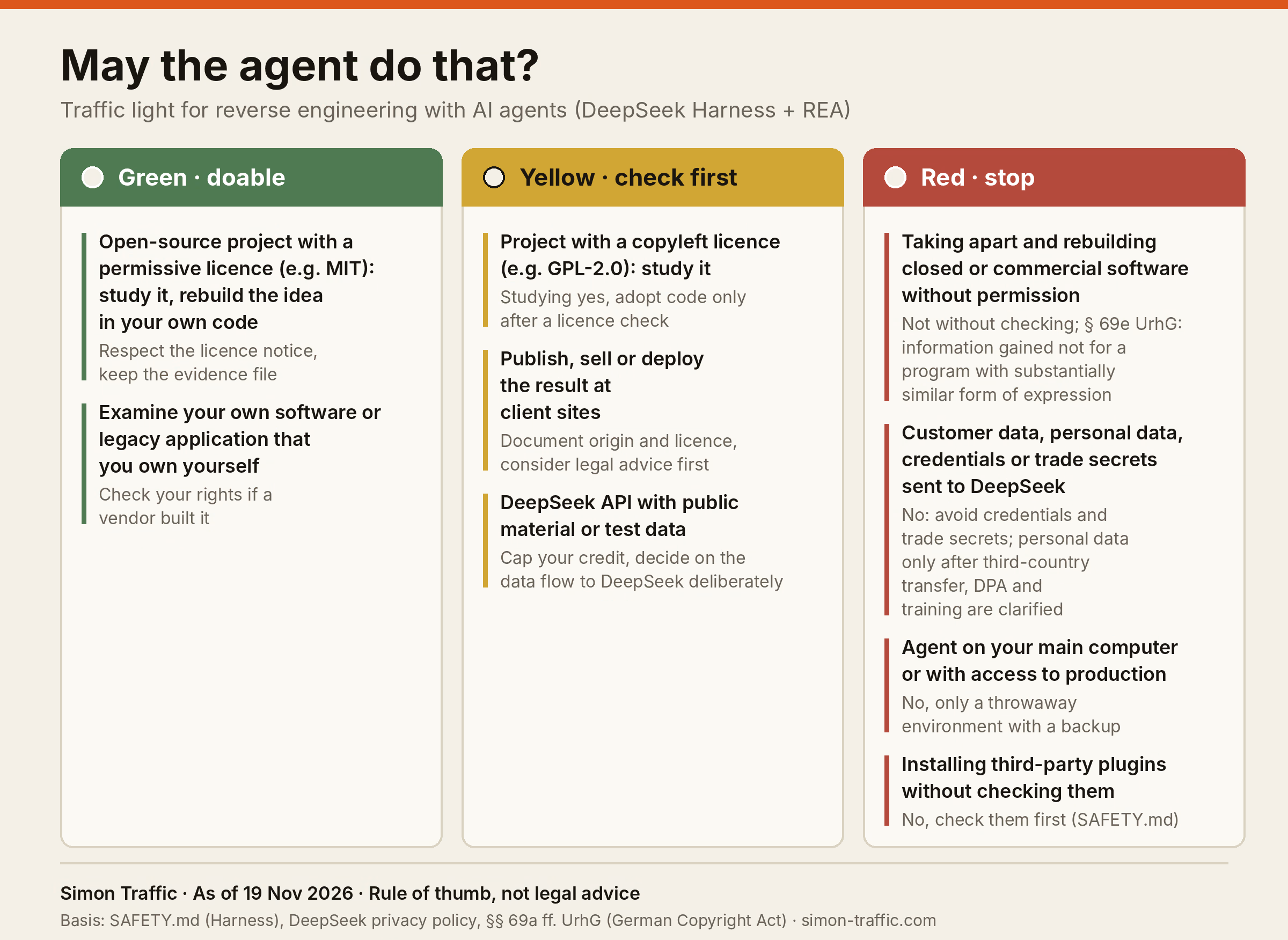
Green means open source projects with a permissive licence and your own software; stop means closed software without permission, customer data going to DeepSeek, the main computer and unchecked plugins. The traffic light is my rule of thumb based on the Harness safety notice, DeepSeek's privacy policy and copyright law. It is not legal advice and does not replace a check in the individual case.2,15,21
| Light | Situation | Recommendation |
|---|---|---|
| Green | Study an open source project with a permissive licence (e.g. MIT), implement the idea in your own code | Observe the licence notice, keep the evidence file |
| Green | Examine your own software or a legacy application that you own yourself | Check the rights if a service provider built it |
| Yellow | Study a project with a copyleft licence (e.g. GPL-2.0) | Studying yes, taking over code only after a licence check |
| Yellow | Publish, sell or use the result with clients | Document origin and licence, consider legal advice beforehand |
| Yellow | Use the DeepSeek API with public material or test data | Limit the credit, decide consciously on the data flow to DeepSeek |
| Red | Take apart and rebuild closed or commercial software without permission | Not without checking; § 69e UrhG (German Copyright Act): information obtained must not be used for a program with a substantially similar form of expression |
| Red | Customer data, personal data, credentials or trade secrets to DeepSeek | No: avoid credentials and trade secrets (SAFETY.md advises against giving access to sensitive credentials and data); personal data only after third-country transfer, DPA and training have been clarified |
| Red | Agent on the main computer or with access to production systems | No, only a disposable environment with a backup |
| Red | Install third-party plugins unchecked | No, check beforehand (SAFETY.md) |
Use the graphic on your site
You may use the graphic freely with a credit to the source. To do so, copy this code:
<a href="https://simon-traffic.com/en/blog/ai-automation/deepseek-harness-and-rea-open-source/"><img src="https://simon-traffic.com/assets/blog/deepseek-harness-rea/deepseek-harness-rea-ampel.en.avif" alt="Is the agent allowed to do that? Traffic light for AI reverse engineering with AI agents (DeepSeek Harness and REA): Green are open source projects with a permissive licence and your own software, yellow are copyleft projects, publishing results and the DeepSeek API with public material, red (stop) are closed software without permission, customer data going to DeepSeek, running on the main computer and unchecked plugins" width="1200" height="876"></a>
<p>Source: <a href="https://simon-traffic.com/en/blog/ai-automation/deepseek-harness-and-rea-open-source/">Simon Traffic, DeepSeek Harness and REA: Is the agent allowed to do that? As of 19/11/2026, not legal advice</a></p>
How do you check the result? Checklist before you trust it
Only trust the agent's result once you have checked five things yourself.
- Open the evidence file. Does
evidence.mdname real files and functions? Open two or three locations in the source folder and check whether they are there. - Read the limits. Is there anything important in the section “What could not be proven”? Then have the agent examine exactly that part next.
- Click through it yourself. Open the result and try every button, every input field and every process.
- Check the real logic. Does the build use the functions the agent found, or does it just show something that looks right? Have it show you in the code where the logic is called.
- Compare the source folder. At the end, compare the source folder with your copy to be sure nothing was changed.
You can gauge how far your business has got with AI agents overall in the article on AI maturity. Another route to multiple agents is shown by the Google Antigravity update.
Limits and open points
The information comes from official repositories, documentation, pricing pages, authority texts and statutes, not from a long-term test of my own. I haven't played through the steps myself, so I give no results, run times or costs of real tasks. What remains open is whether API inputs are used for training, whether DeepSeek offers a data processing agreement, and which EU providers host the open model and what privacy they offer.15,16,20,23 The copyright tables summarise statutory texts and are not legal advice.21
Conclusion
DeepSeek Harness with REA is worthwhile for agencies and small businesses that want to try out how an open source agent examines, documents and rebuilds programs, but only as an experiment in a disposable environment. In my assessment, the price is no obstacle (V4.1 Flash: €0.137 per million input tokens without a cache hit off-peak, €0.274 at peak).12,14 The hurdles are maturity, privacy and licensing: according to the manufacturer, Harness has not undergone a security review, DeepSeek stores data in China according to its privacy policy, and you may only take over other people's code in line with the licence.2,15,21 I would start with a small excerpt of an open source project with a permissive licence, use test data and a small credit balance, check the evidence file yourself and keep customer data out. If your business has several tasks that an agent could take on, let's have a quick chat about which one is worth doing first.
Frequently asked questions about DeepSeek Harness
What is DeepSeek Harness?
An open source agent app from DeepSeek AI under the MIT licence (command dsh), in which everything runs through plugins. According to the README and safety notice, it is a developer preview, has not undergone a security review and is not production-ready.1,2,7
Is it allowed to rebuild software with REA?
That depends on what you examine and what you take over. Ideas and principles of a program are not protected by copyright, while the forms of expression of a program, including the code, generally are (§ 69a(2) UrhG, German Copyright Act). Reproduction of the code or translation of the code form without consent (decompilation) is governed by § 69e UrhG as an exception for the interoperability of an independently created program, and the information obtained must not be used for a program with a substantially similar form of expression. For open source projects, the licence (for example MIT or GPL-2.0) determines what you may do with code. This is not legal advice.21,22,25
Where does my data go if I use DeepSeek Harness with the DeepSeek API?
To DeepSeek. The privacy policy names the People's Republic of China as the storage location for the services, and the terms of use allow, under conditions, the use of inputs and outputs to improve the services. Whether that applies to API inputs and whether there is a data processing agreement is not clarified in the pages checked. So don't enter customer data before that is clarified. REA analyses locally, but your agent receives the results, and its model provider has its own data policy.8,15,16,23
Can I use this locally without the API?
Harness itself runs locally. For the model, you can enter other providers or your own server via “Custom model API”. The model weights of DeepSeek V4.1 Flash are open (licence tag MIT), but have about 763 billion parameters, which is probably far too large for a normal office computer.1,4,20
What does DeepSeek Harness really cost?
Harness and REA are free to use under the MIT licence,7,11 but using the model costs money: with DeepSeek V4.1 Flash, input without a cache hit is €0.137 per million tokens off-peak (peak: €0.274), and output is €0.547 (peak: €1.094). How many tokens a run uses depends on the task.12,14
Is DeepSeek Harness safe enough for business use?
Not according to the manufacturer: Harness has not undergone a security review and can run code and commands. The recommendations are a disposable VM or container, minimum permissions and backups.2
Does REA work with large programs?
The sources provide no documented figures on this. The REA docs name requirements for each target and point out that the evidence file of a real application can grow to hundreds of megabytes. Try it on a small excerpt.8,10
Suggested citation
Gütter, Simon (2026): DeepSeek Harness and REA: Open-Source AI Agent, Costs in Euros, Privacy and Law. Simon Traffic, 19 November 2026. https://simon-traffic.com/blog/ki-automatisierung/deepseek-harness-rea/
Sources
- DeepSeek AI: DeepSeek Harness, README, GitHub, retrieved on 19/11/2026. https://github.com/deepseek-ai/deepseek-harness
- DeepSeek AI: DeepSeek Harness, Safety (SAFETY.md), GitHub, retrieved on 19/11/2026. https://github.com/deepseek-ai/deepseek-harness/blob/master/SAFETY.md
- DeepSeek Harness: Use the Web UI, documentation, retrieved on 19/11/2026. https://deepseek-harness.github.io/deepseek-harness/en/guide/quickstart
- DeepSeek Harness: Configure models, documentation, retrieved on 19/11/2026. https://github.com/deepseek-ai/deepseek-harness/blob/master/docs/user/guide/providers.md
- GitHub: Repository data and releases of deepseek-ai/deepseek-harness (stars, creation, pre-releases), API, retrieved on 19/11/2026. https://api.github.com/repos/deepseek-ai/deepseek-harness and https://api.github.com/repos/deepseek-ai/deepseek-harness/releases
- npm: @deepseek-ai/dsh, registry details (version, Node requirement), retrieved on 19/11/2026. https://www.npmjs.com/package/@deepseek-ai/dsh
- DeepSeek AI: DeepSeek Harness, licence (MIT), GitHub, retrieved on 19/11/2026. https://github.com/deepseek-ai/deepseek-harness/blob/master/LICENSE
- morluto: REA, Reverse Engineer Anything, README, GitHub, retrieved on 19/11/2026. https://github.com/morluto/rea
- REA: Client configuration, section DeepSeek Harness, documentation, retrieved on 19/11/2026. https://github.com/morluto/rea/blob/main/docs/getting-started/client-configuration.md
- REA: CLI and Evidence, documentation, retrieved on 19/11/2026. https://github.com/morluto/rea/blob/main/docs/getting-started/cli.md
- REA: Repository data, releases and npm package rea-agents (version 6.9.0, Node requirement, MIT), retrieved on 19/11/2026. https://api.github.com/repos/morluto/rea, https://api.github.com/repos/morluto/rea/releases and https://www.npmjs.com/package/rea-agents
- DeepSeek API Docs: Models & Pricing, retrieved on 19/11/2026. https://api-docs.deepseek.com/quick_start/pricing
- DeepSeek API Docs: Change Log, retrieved on 19/11/2026. https://api-docs.deepseek.com/updates
- Europäische Zentralbank: Euro reference rate US dollar, 18/11/2026 (€1 = $1.0968), retrieved on 19/11/2026. https://data-api.ecb.europa.eu/service/data/EXR/D.USD.EUR.SP00.A
- DeepSeek: Privacy Policy, as of 10/02/2026, retrieved on 19/11/2026. https://cdn.deepseek.com/policies/en-US/deepseek-privacy-policy.html
- DeepSeek: Open Platform Terms of Service, published 22/04/2026, effective 29/04/2026, retrieved on 19/11/2026. https://cdn.deepseek.com/policies/en-US/deepseek-open-platform-terms-of-service.html
- Berliner Beauftragte für Datenschutz und Informationsfreiheit: Pressemitteilung vom 27.06.2025 (press release of 27/06/2025 on reporting the AI app DeepSeek to Apple and Google), retrieved on 19/11/2026. https://www.datenschutz-berlin.de/pressemitteilung/berliner-datenschutzbeauftragte-meldet-ki-app-deepseek-in-deutschland-bei-apple-und-google-als-rechtswidrigen-inhalt/
- Berliner Beauftragte für Datenschutz und Informationsfreiheit: Jahresbericht 2025 (annual report 2025), section “Beantragte Sperrung der chinesischen KI-App DeepSeek”, retrieved on 19/11/2026. https://www.datenschutz-berlin.de/fileadmin/user_upload/pdf/jahresbericht/BlnBDI_Jahresbericht-2025.pdf
- Garante per la protezione dei dati personali: decision of 30/01/2025 on DeepSeek, retrieved on 19/11/2026. https://www.gpdp.it/web/guest/home/docweb/-/docweb-display/docweb/10098477
- Hugging Face: model pages deepseek-ai/DeepSeek-V4.1-Flash and DeepSeek-V4.1-Flash-1017 (licence tag MIT, parameter count), retrieved on 19/11/2026. https://huggingface.co/deepseek-ai/DeepSeek-V4.1-Flash and https://huggingface.co/deepseek-ai/DeepSeek-V4.1-Flash-1017
- Bundesministerium der Justiz: Urheberrechtsgesetz (German Copyright Act), §§ 69a, 69c, 69d, 69e, Gesetze im Internet, retrieved on 19/11/2026. https://www.gesetze-im-internet.de/urhg/__69a.html, https://www.gesetze-im-internet.de/urhg/__69c.html, https://www.gesetze-im-internet.de/urhg/__69d.html and https://www.gesetze-im-internet.de/urhg/__69e.html
- GitHub: Repository data (stars, licence identifier) and READMEs of huggingface/smolagents, puckeditor/puck and discourse/discourse, retrieved on 19/11/2026. https://api.github.com/repos/huggingface/smolagents, https://api.github.com/repos/puckeditor/puck, https://api.github.com/repos/discourse/discourse, https://github.com/huggingface/smolagents, https://github.com/puckeditor/puck and https://github.com/discourse/discourse
- DeepSeek: Terms of Use, as of 27/03/2026, retrieved on 19/11/2026. https://cdn.deepseek.com/policies/en-US/deepseek-terms-of-use.html
- DeepSeek API Docs: Agent Integrations, DeepSeek Harness (the page carries the HTML title “Your First API Call” in the raw text, section “Integrate with Agent Tools”), retrieved on 19/11/2026. https://api-docs.deepseek.com/quick_start/agent_integrations/deepseek_harness
- Free Software Foundation: GNU General Public License, Version 2, clause 2 b, retrieved on 19/11/2026. https://www.gnu.org/licenses/old-licenses/gpl-2.0.txt
- REA: Installation and setup, documentation (client identifiers from rea-agents 6.5.0, Hopper demo), retrieved on 19/11/2026. https://github.com/morluto/rea/blob/main/docs/getting-started/installation.md
As of: 19 November 2026. Features, versions, prices and terms of use of DeepSeek Harness, REA and the DeepSeek API may change; Harness is a developer preview. Euro values of the US dollar prices are converted with the ECB reference rate of 18/11/2026 (€1 = US$1.0968) and rounded. This article is not legal advice.