
SaaSpocalypse: Is SaaS Dead? What the Data and Practice Really Show in 2026

Some people say yes, SaaS is dead. In early 2026 software shares fell sharply, and the stock market even found a nickname for it: SaaSpocalypse. At the same time, Gartner expects software spending to grow by around 15 per cent in 2026. Both are true. This article shows what is behind it, who is really replacing subscriptions by building their own tools, and where that gets expensive.
SaaS is not dead. The market keeps growing, although part of that growth is price rises for software companies already have. Small single-purpose tools and per-user pricing are under pressure. Building with AI pays off for clearly defined internal tools. The real costs lie not in building, but in maintenance, security and data protection. And if you use ChatGPT or Claude on a subscription, you are often just replacing SaaS with SaaS.
What is the SaaSpocalypse?
SaaSpocalypse (in German also called SaaS-Pokalypse) is the nickname for the slump in software shares from late January to February 2026. New AI agent products are seen as the trigger, among them Anthropic's announcement of Claude Cowork.1 Among those hit were project management and CRM providers such as Atlassian and Salesforce.2
The worry behind it is simple: if one person doing the work of five with AI agents means the company buys one licence instead of five. And if workflows can be built without having to lift a mouse, some customers will simply build their tools themselves.
How big the damage on the stock market was is disputed. Figures quoted range from a few hundred billion to two trillion dollars, depending on the period and the source. The head of AWS called the panic “overblown” and pointed to interest rates and inflation as contributing causes.1
What does SaaS mean?
SaaS stands for Software as a Service: software you don't buy and install, but use in the browser and pay for monthly or yearly. The provider takes care of updates, servers and security. Typical examples are Calendly, HubSpot, Slack or Microsoft 365. Billing is usually per user, and it is exactly this pricing model that AI is putting under pressure.
Is SaaS dead? What the numbers say
Things should actually have got even worse for software vendors since February, because AI has got even better since then. The numbers say something different. One caveat: whoever publishes them often has a vested interest.
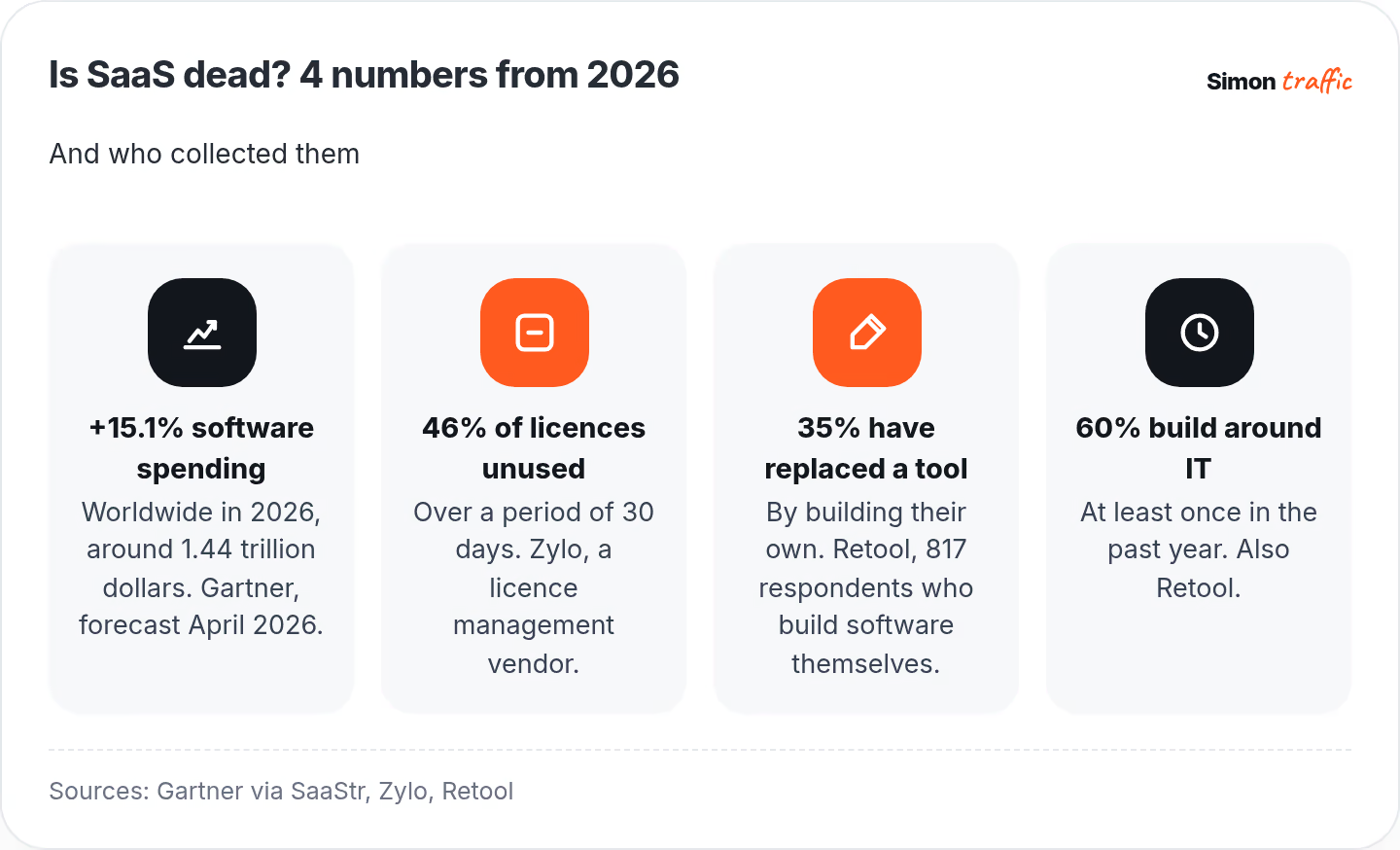
Is SaaS dead? 4 numbers from 2026
And who collected them
- +15.1% software spendingWorldwide in 2026, around 1.44 trillion dollars. Gartner, forecast April 2026.
- 46% of licences unusedOver a period of 30 days. Zylo, a licence management vendor.
- 35% have replaced a toolBy building their own. Retool, 817 respondents who build software themselves.
- 60% build around ITAt least once in the past year. Also Retool.
The market is growing, partly through price
Gartner expects software spending to rise by 15.1 per cent in 2026, to around 1.44 trillion dollars. In February, in the middle of the SaaSpocalypse, Gartner had cut the forecast to 14.7 per cent, then raised it again in April.3 But what is the money being spent on? Part of it simply goes into higher prices for software companies already have. AI features are added, and they cost more. According to Gartner analyst John-David Lovelock, generative AI is often hidden in exactly these price rises.4
Many companies pay for software nobody uses
I'd be much more interested in this: how many companies have ever checked how much of their software they actually use? According to Zylo, 46 per cent of licences sit unused for a month.5 Zylo does sell licence management itself, though, so the figure is also advertising. Still, it is worth a look: cancelling unused licences saves money immediately, with no need to build anything.
Building your own is real, but the figure is often quoted wrongly
According to Retool, 35 per cent of respondents have replaced at least one SaaS tool by building their own, and 78 per cent want to build more of their own tools in 2026.6 In headlines this often becomes “35 per cent of companies”. But Retool asked 817 people who build software themselves anyway, including Retool customers. The things replaced most often are workflow automations (35 per cent) and internal admin tools (33 per cent), followed by BI dashboards (29 per cent) and CRM and form tools (25 per cent).6 I have not found an independent study for Germany that proves a trend towards building your own.
SaaS replaces SaaS
One point often gets lost in the debate: ChatGPT and Claude are SaaS themselves. If you cancel your Calendly subscription and pay for ChatGPT Plus or Claude Pro instead, you have swapped one subscription for another. In other words, SaaS replaces SaaS. It is a little different if you use AI via the API. Then you pay by usage instead of per month, but still to a provider.
So the more honest question is not “SaaS or build your own?”, but: for which task am I paying for a subscription when a simple tool of my own would do the job just as well?
Cancelling subscriptions with vibe coding: does it work?
Vibe coding means you describe in plain language what a program should do, and an AI writes the code. Tools for this include Claude Code, Lovable and Replit. With them, small tools often take hours or days instead of weeks.
Two examples from practice: Jason Lemkin of SaaStr replaced a paid tool for his sponsor portal with an app of his own in about a day and a half, built by someone with no programming training.7 The UK's National Cyber Security Centre (NCSC) reports on a start-up that was due to pay double the price at renewal, because more users had pushed it into a more expensive plan. Instead of renewing, the lead developer rebuilt the tool with AI.8
I'm using vibe coding to focus on being able to cancel my subscriptions. It started with my appointment booking: after the trial period, the provider deactivated my booking page because reminders from the paid plan were still switched on. Since 13 October 2026, my own appointment booking has been running instead, with reminders by email and SMS. In principle, I achieve the same as with the subscription.
What is often forgotten when building your own: maintenance, security, data protection
Building has become cheap with AI. Running it hasn't. The subscription fee doesn't just pay for the software, but also for updates, security and support. When you build your own, you take that on yourself, and permanently.
Maintenance
Lemkin writes openly that he now spends a considerable part of his day maintaining the apps he built himself. His question: who looks after ten apps and twenty agents over the next five years?7 The licence saved rarely justifies building your own on its own. The gain lies more in the tool fitting your process exactly.
Security
AI first builds something that runs, not necessarily something that is secure. The NCSC names “slopsquatting” as one new type of attack, for example: the AI invents names of software packages that don't exist, and attackers register exactly those names with malicious code.8 Without review rounds and tests, building your own becomes risky. How many people have thought about this before building?
For my tools I rented a server of my own. There I know myself what is going on and how security is organised. But that also means that if something goes wrong there, I'm responsible. More on this in the glossary under self-hosting.
Data protection
As soon as your tool processes customer data, you have to answer the GDPR questions yourself that the provider otherwise prepares for you: where are the servers? Which services receive data, for example for email or SMS? Is there a data processing agreement with each of them? And who builds their tool so that it is GDPR-compliant from the start? With a SaaS provider, ideally this is already done; when you build your own, it is your job.
When building your own instead of SaaS pays off, and when it doesn't
The debate is not about whether SaaS will disappear, but about which SaaS products will be replaced. Forrester draws the line at large business applications such as the online shop, at least for now.9 The NCSC expects companies to decide differently between buying, building and going without in the coming years, but not overnight.8
- small tool with one clear task
- few users, mostly internal
- subscription gets more expensive with every user
- a process the standard product can't handle
- someone looks after maintenance long-term
- many users or customer data on a large scale
- payments and legal obligations
- core systems such as shop, ERP, accounting
- nobody has time for updates and security
Before you build: First look at which subscriptions you don't use at all. Cancelling is the cheapest way of building your own.

Appointment booking without a subscription
My own replacement has turned into a tool: the appointment booking from Simon Traffic. Online booking, confirmation and reminder by email, SMS reminders via seven.io, rebooking via a link and syncing with Google Calendar. As a WordPress plugin or on your own server, free and without a subscription.
- No subscription
- Your own server or WordPress
- Reminder by email and SMS
- Rebooking via a link
Conclusion: SaaS isn't dead, but not every subscription has to stay
The SaaSpocalypse was above all a stock market panic. The software market keeps growing, only part of the growth is paid for through higher prices for existing software. Small single-purpose tools and per-user billing are under pressure. If you want to replace subscriptions with vibe coding, you should start small, be honest about maintenance and security costs, and not forget that ChatGPT and Claude are subscriptions themselves. So, is SaaS dead? No. For me this is a thought experiment for now. But my appointment booking already runs without a subscription.
Frequently asked questions about the SaaSpocalypse
Is SaaS dead?
No. Gartner expects worldwide software spending to grow by 15.1 per cent in 2026. Simple single-purpose tools and per-user pricing are under pressure, because companies can build such tools themselves with AI or need fewer licences.
What does SaaSpocalypse mean?
SaaSpocalypse (in German also called SaaS-Pokalypse) is the nickname for the slump in software shares from late January to February 2026. It was triggered by the worry that AI agents make per-user licences redundant and that customers will build software themselves.
What does SaaS mean?
SaaS stands for Software as a Service: software you use in the browser and pay for with a subscription, instead of buying and installing it. The provider takes care of servers, updates and security.
What is vibe coding?
With vibe coding, you describe in plain language what a program should do, and an AI writes the code. Well-known tools include Claude Code, Lovable and Replit. This lets you build small tools without any programming training.
Can I replace a SaaS subscription with my own tool?
For small, clearly defined tools, often yes, for example forms, internal overviews or appointment booking. But factor in the effort for maintenance, security and data protection, which the provider carries when you have a subscription.
Is software built with AI secure?
Not automatically. AI first builds something that works, not necessarily something that is secure. The UK's National Cyber Security Centre (NCSC) mentions, for example, invented package names that attackers then register. Review rounds, tests and regular updates are a must.
What software should you not build yourself?
Anything with many users, payments, large volumes of customer data or legal obligations, such as a shop, ERP or accounting. There the provider takes care of security updates, support and part of the liability, and a mistake quickly gets expensive.
How can I cut SaaS costs without building anything myself?
First check which licences nobody has used in the last 30 days, and cancel them. After that, look at tools that do the same thing, and at per-user plans that jump to a more expensive tier as you grow.
Sources
- Cirra: SaaSpocalypse, AI agents and the SaaS market (timeline, AWS quote). cirra.ai
- Cohan, P. (2026): SaaSpocalypse Now? AI Is Disrupting SaaS, But Not All Software Is Doomed. Forbes, 06/02/2026. forbes.com
- Lemkin, J.: Gartner: Software Spend Now $1.44 Trillion in 2026, Revised Back Up to 15.1%. SaaStr. saastr.com
- Computing: Cost of GenAI is a negative for software companies, Gartner. computing.co.uk
- Zylo: Reduce License Waste (figures from the SaaS Management Index). zylo.com/solutions/license-waste
- Retool (2026): Build vs. Buy Report 2026, survey of 817 people who build software themselves, including Retool customers, late 2025. retool.com
- Lemkin, J.: The 90/10 Rule for AI Agents, Updated: We Replaced a Paid SaaS Tool in a Day With a Vibe-Coded App. SaaStr. saastr.com
- National Cyber Security Centre (UK): Vibe check: AI may replace SaaS (but not for a while). ncsc.gov.uk
- Forrester: No, You Can't Just Vibe Code Commerce (Yet). forrester.com
Many of the numbers in the debate come from vendors with a vested interest. I checked them against the originals and named the sources, accessed on 30/10/2026.
Simon Gütter is a marketing expert who has worked for years at the intersection of marketing, sales and automation. He finds the places where companies lose time and customers, and builds processes that run on their own: from appointment booking to reporting. More about Simon