
Gemini Robotics 2.5: What Google's Robot AI Can Do and What It Means for Businesses
Can a robot in a working car factory pick metal parts out of a crate and sort them in the right order, without anyone having programmed every single movement beforehand? That is exactly what Google DeepMind has shown with Gemini Robotics 2.5, unveiled on 10 November 2026. In a test at Mercedes-Benz plants, the success rate was 96 per cent.1 I looked at what is behind the model, what the numbers mean and what of it is already relevant today for small and mid-sized businesses.
Gemini Robotics 2.5 is an AI model that controls robots: it sees through cameras, understands instructions in plain language and turns them into movements of arms and hands. According to Google, it manages significantly more fine-motor tasks than its predecessor, such as packing pastries with tongs or undoing a bow, and works 20 to 30 per cent faster. You can't buy or use the model yourself yet; for now it only goes to robotics partners such as Apptronik. What you can try today is the planning model Gemini Robotics ER 2 in Google AI Studio.1,2
The key figures
- 96% success rate when sorting car parts with the humanoid robot Apollo 2 in Mercedes plants in Kecskemét (Hungary) and Sindelfingen.1
- 30 to 100% higher success rate than its predecessors, depending on the task, with 20 to 30% shorter execution time.1
- Over 200 different tasks tested, from pipetting to serving with tongs.1
- +33% and +43% more tasks completed safely near obstacles and near people.1
- 99.5 instead of 82% resistance to disguised, dangerous instructions (Gemini 4 Argon compared with Gemini Robotics ER 2).1
What is Gemini Robotics 2.5?
Gemini Robotics 2.5 is a so-called Vision-Language-Action model, or VLA model for short. The name describes how it works: it receives camera images (vision) and an instruction in language (language), and from these it directly outputs control commands for motors (action).1,3 Classic industrial robots work differently. They follow a fixed, programmed path, and if a part is lying crooked in the crate, they stop or miss it. A VLA model is meant to adapt to such deviations, because it sees the scene and understands the task.
Google relies on two models working together. The planning model Gemini Robotics ER 2 (ER stands for Embodied Reasoning) keeps the overview: it understands the space, breaks a task down into steps, talks to people and checks whether a step has worked. The action model Gemini Robotics 2.5 turns the individual steps into movements.1,4 For robots that have to work without internet or without delay, there is also a smaller variant that runs directly on the device.4
| Model | Role | Availability (as of 14 November 2026) |
|---|---|---|
| Gemini Robotics 2.5 | Action model (VLA): controls arms, hands and the whole body | robotics partners only |
| Gemini Robotics ER 2 | Planning model: understands space, plans steps, coordinates several robots | public preview in Google AI Studio and the Gemini API, closed preview in the Gemini Enterprise Agent Platform |
| Gemini Robotics On-Device 2 | small VLA model, runs locally on the robot | early-access partners |
| Gemini 4 Argon | general-purpose model, speeds up robotics research | Gemini API (paid), Google AI Ultra |
The model is not tied to one particular robot. Google shows it on the humanoid robot Apollo 2 from Apptronik with a five-finger hand (SharpaWave, 22 degrees of freedom) and on a Franka Duo platform with two simple two-finger grippers.1 According to Google, even the on-device variant of version 2 could be adapted to new two-armed robots in a few hours, mostly with fewer than 200 examples.4
What's new compared with Gemini Robotics 2?
Gemini Robotics 2 arrived in July 2026 and controls robots with the whole body, from foot to fingertip: walking, bending and grasping in one sequence.4 Version 2.5 puts the emphasis on dexterity and reliability. Google names three areas: more finger dexterity, more dependable results in real operation and more safety.1
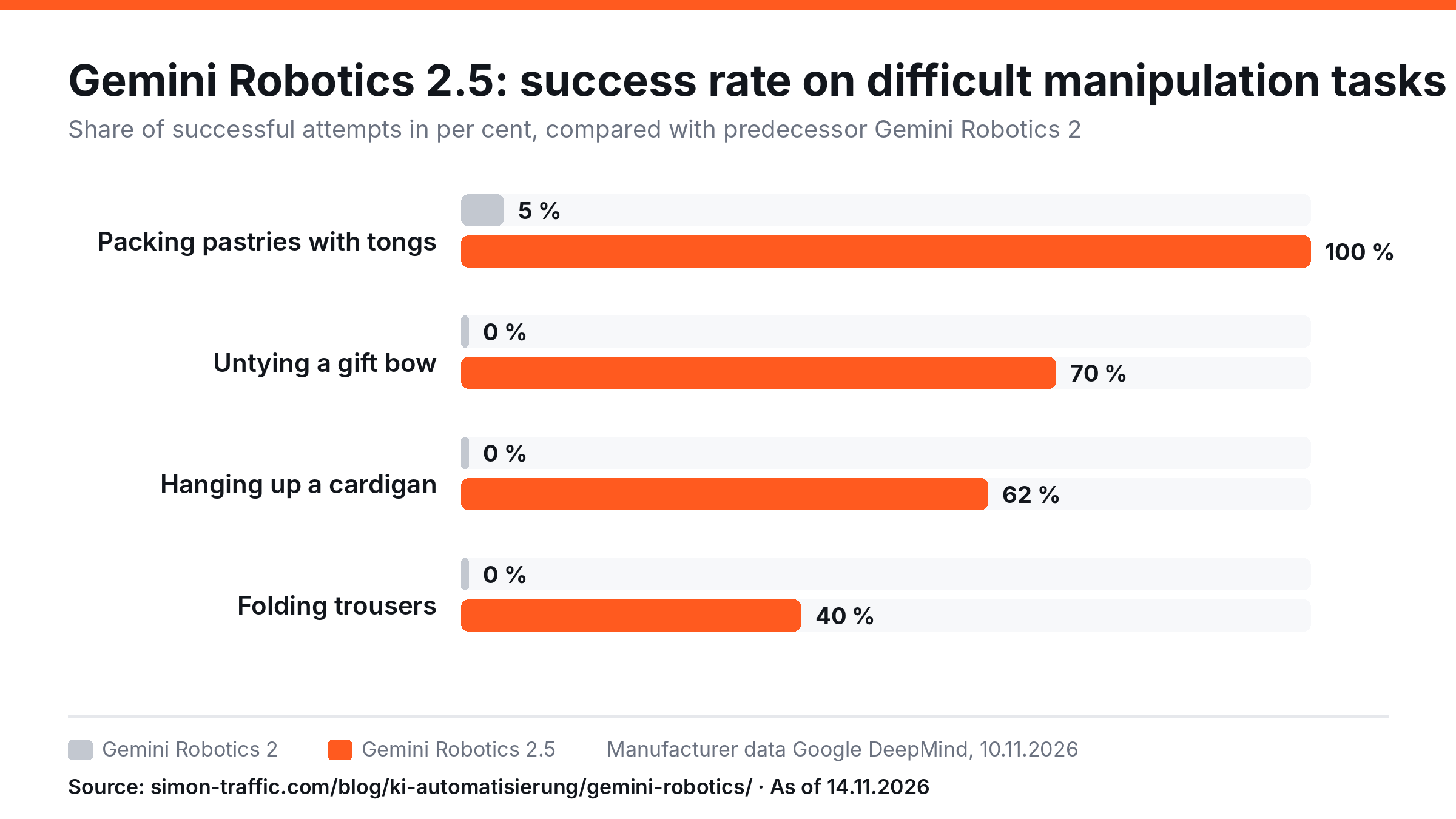
The leap is clearest with soft or delicate things. Fabric and ribbons deform with every touch, and pastry is quickly crushed. For robots, this has been among the hardest problems for years. In Google's own tests it looks like this:1
| Task | Gemini Robotics 2 | Gemini Robotics 2.5 |
|---|---|---|
| Packing pastry with tongs | 5% | 100% |
| Undoing a gift bow | 0% | 70% |
| Hanging up a cardigan | 0% | 62% |
| Folding trousers | 0% | 40% |
Use the graphic on your own site
You may use the graphic freely with attribution. To do so, copy this code:
<a href="https://simon-traffic.com/en/blog/ai-automation/gemini-robotics-robot-ai-for-businesses/"><img src="https://simon-traffic.com/assets/blog/gemini-robotics/gemini-robotics-2-5-erfolgsquote.en.png" alt="Gemini Robotics 2.5: success rate on difficult manual tasks" width="1200" height="675"></a>
<p>Source: <a href="https://simon-traffic.com/en/blog/ai-automation/gemini-robotics-robot-ai-for-businesses/">Simon Traffic, Gemini Robotics 2.5</a></p>
What strikes me here: the trousers are only folded cleanly in 40 per cent of attempts. For a laundry, that would be worthless. What is interesting, though, is the direction, because with version 2, three of these four tasks were still at zero. All the values come from Google itself; there are no independent measurements so far.
The real-world test at Mercedes-Benz: kitting at 96 per cent
For me, the most exciting part of the announcement is not the lab but the factory. Together with Apptronik and Mercedes-Benz, Google DeepMind put Apollo 2 humanoid robots to work on running production lines, in Kecskemét in Hungary and in Sindelfingen.1
The task is called kitting: individual parts are taken out of large crates and sorted into containers in the exact order in which they will later be needed on the line for a specific vehicle. It is monotonous, physically demanding and still has to be right. In the test, Apollo 2 picked metal brackets out of the supply crates and placed them in the sorting containers. The planning model ER kept track of the process, while the action model 2.5 controlled hands and arms and compensated for gaps. Result: a 96 per cent success rate.1
Apptronik CEO Jeff Cardenas says the models improved a lot after a few weeks of further training and carried over to Mercedes production with hardly any loss of performance.1
Important for putting this in context: Google explicitly speaks of a proof of concept, that is, a feasibility test. There is no mention of regular operation. 96 per cent sounds high, but it also means that out of 100 parts, on average four grasps don't work. On a line that runs to a cycle time, you would still need people to step in. Even so, this is a different level from the usual trade-fair videos, because it happened in a real factory and not on a tidy lab set.
Gemini 4 Argon: practising in simulation instead of only on the real robot
Robots learn slowly because every attempt in the real world takes time. Set up the camera, let the robot run, look at the errors, readjust, and do that thousands of times. This is where Gemini 4 Argon comes in, Google's general-purpose flagship model, which was also presented for robotics in October 2026.5
According to Google, Argon has greatly accelerated the development of Gemini Robotics 2.5, in three ways:1
- Digital twin: From a real camera scene, Argon builds a realistic simulation of the same environment.
- Practice runs: In this simulation it generates thousands of varied runs. Together with real demonstrations, the robot learns faster to cope with new scenes and objects.
- Error analysis: Argon watches videos of failed attempts, forms hypotheses about what went wrong, and tests improvements first in simulation and then on the real robot.
An example from Google's developer blog shows how much this brings. From a single photo of a table, Argon independently built a physics simulation, generated over 4,500 varied practice runs in it and handed them to the robot model for further training. Afterwards, the real robot's success rate rose from 56 to 75 per cent, and the time per task fell from 35 to 24 seconds.5
On the ERQA benchmark, which tests spatial understanding in 3D environments, Argon reaches 87 per cent according to Google, ahead of all other leading models.5 For me, this is the real lever behind the announcement. If a large part of robot training happens in simulation, the time and cost of every new task go down. And that is exactly what decides in the end whether a robot is worthwhile in a business with many changing tasks.
Safety: how Google protects robots from errors and manipulation
A language model that answers wrongly is annoying. A robot that grasps wrongly can hurt someone. Google names two innovations.1
Safety while acting. During execution, Gemini Robotics 2.5 uses an additional reasoning aid that steers it around hazards in real time, similar to the safety filters in a chatbot. In Google's tests, this meant 33 per cent more tasks were completed safely when obstacles were in the way, and 43 per cent more when people were nearby.1 Gemini Robotics ER 2 can already recognise when someone gets too close and bring the robot to a safe stop.4
Protection against disguised commands. With ASIMOV-Jailbreak, Google has published an open test. It contains hundreds of instructions that wrap dangerous orders in harmless packaging, spread across dozens of scenes. Gemini 4 Argon resists 99.5 per cent of these attempts; the previous baseline, Gemini Robotics ER 2, was at 82 per cent.1 The test dataset is available on Hugging Face under the CC BY 4.0 licence (access after agreeing to the terms of use). Robotics companies can use it to test their own systems.6
How does Google compare with Tesla, Nvidia and others?
If you search for AI robots, you quickly end up at Tesla Optimus or Atlas from Boston Dynamics. The most important difference: Google doesn't sell robots of its own, but develops the brain that goes into other manufacturers' robots. The body of Apollo 2 comes from Apptronik, the five-finger hand from Sharpa and the control from Google DeepMind.1 Boston Dynamics is also one of Google's partners.3 Tesla, by contrast, develops robots and software in-house, Nvidia supplies its own models for humanoid robots with Isaac GR00T, and Chinese manufacturers such as Unitree are bringing cheap hardware to market.
For businesses this matters because it opens up two paths. Either you later buy a complete system from one manufacturer, or a robot running a model such as Gemini Robotics. Which path wins out is open.
Physical AI: what does it mean for small and mid-sized businesses?
Physical AI is currently one of the fastest-growing search topics. That doesn't mean, though, that a humanoid robot will be standing in your workshop tomorrow. My assessment, as things stand today:
In the short term, nothing changes for most businesses. Gemini Robotics 2.5 is only available to partners; there is no public interface and no price. If you buy a humanoid robot now, you won't get this model with it.
In the medium term, tasks like kitting are the first candidates. I mean activities that repeat often but where the parts don't always lie the same way: order picking, sorting, packing, loading components. That is exactly where classic industrial robots fail, because the environment is too messy, and exactly where Google is aiming. There are also open questions that every business has to settle before such a robot works alongside people: who is liable if it damages something or injures someone, and how does it fit with the safety standards for machinery?
What you can do right now has little to do with robots. Like any AI application, a robot with AI needs clearly described processes. If you document your manual steps, sequences and failure cases cleanly today, that is the foundation for any later automation, digital or physical. That is classic process optimisation. You can assess where your business stands on AI overall in a few minutes with the AI maturity check. For most small companies, the quickest wins still lie in digital workflows such as appointment booking, enquiries and receipts, often already with an AI agent or a local model such as Nemotron 3.5 Bolt.
What you can try today
Even without a robot, you can already see how Google's robotics AI thinks:
- Gemini Robotics ER 2 in Google AI Studio. The planning model is available there as a public preview and accepts text, images, video and audio. For example, you upload a photo of a shelf or a workbench, have it recognise objects, and have it plan and explain a sequence in steps.2
- Gemini 4 Argon via the Gemini API. Argon is available in the paid tier of the Gemini API and to Google AI Ultra subscribers.5 In Google's developer blog you'll find example prompts, such as how Argon builds simulations or controls a robot without prior training.
- Waiting list for testers. According to Google, it works with over 100 selected testers, from large automation firms to robotics start-ups, and is taking on further interested parties via a waiting list.3
- ASIMOV benchmark. If you develop robots yourself, you can test your own safety with the open dataset.6
Timeline: Gemini Robotics from 2025 to today
| Date | Release | What's new |
|---|---|---|
| March 2025 | Gemini Robotics | first model, Gemini controls robots |
| September 2025 | Gemini Robotics 1.5 | AI agents in the physical world, transfer of movements between robots |
| April 2026 | Gemini Robotics-ER 1.6 | better planning and spatial understanding |
| July 2026 | Gemini Robotics 2 | whole-body control, several robots working as a team |
| October 2026 | Gemini 4 Argon for robotics | simulation, digital twins, error analysis |
| November 2026 | Gemini Robotics 2.5 | more dexterity, factory test at Mercedes, ASIMOV-Jailbreak |
Conclusion: a big step, but not yet a product
Gemini Robotics 2.5 shows that AI-controlled robots are leaving the lab. 96 per cent at kitting in a real car factory and the leap with soft, delicate objects are impressive, even if all the numbers come from Google itself. For me, the real progress lies in the training: if robots get a large part of their practice in simulation, every new task gets cheaper.
For small and mid-sized businesses, this is still a topic to watch today, not to buy. But if you describe your processes cleanly now and introduce digital automation, you'll be prepared when physical AI becomes affordable.
Frequently asked questions about Gemini Robotics
What is Gemini Robotics?
Gemini Robotics is a model family from Google DeepMind that controls robots with AI. It consists of a planning model (Gemini Robotics ER 2), an action model (Gemini Robotics 2.5) and a small variant for use directly on the robot (On-Device 2).3
Can I buy or use Gemini Robotics 2.5?
No, not yet. Gemini Robotics 2.5 is being distributed to robotics partners such as Apptronik. The planning model Gemini Robotics ER 2 can be used publicly in Google AI Studio. There is a waiting list for early access.1,3
What is a VLA model?
VLA stands for Vision, Language, Action. Such a model receives camera images and an instruction in language and directly generates movement commands for a robot from them. So it doesn't have to be programmed for every single movement.1
What is the difference between physical AI and embodied AI?
Both terms mean AI that doesn't just process text or images but acts in the physical world, for example in a robot. Embodied AI emphasises the body, meaning that the AI perceives through sensors and acts through motors. Embodied AI comes more from research, while physical AI is the common industry and market term. In practice, both usually mean the same thing.
Which robots does Gemini Robotics 2.5 work with?
Google shows it on the humanoid robot Apollo 2 from Apptronik and on the Franka Duo platform with two gripper arms. The model family is designed to work with many robot types. Partners include Apptronik, Agile Robots and Boston Dynamics.1,3
Are humanoid robots now working in production at Mercedes-Benz?
Not in regular operation. The use of Apollo 2 in Kecskemét and Sindelfingen was a feasibility test on running lines, in which the robots sorted parts with a 96 per cent success rate.1
When will AI robots reach small businesses?
There is no date. Google names neither a price nor a date for broad availability.1 Large industrial companies and logistics firms are likely to benefit first, with tasks such as kitting and order picking. Until then, it is worth it for smaller businesses to document their processes and introduce digital automation.
What is Gemini 4 Argon?
Gemini 4 Argon is Google's general-purpose flagship model. In robotics, it builds simulations and digital twins from camera images, generates practice runs and analyses errors. It is available via the paid Gemini API and Google AI Ultra.5
Suggested citation
Gütter, Simon (2026): Gemini Robotics 2.5: What Google's Robot AI Can Do and What It Means for Businesses. Simon Traffic, 14 November 2026. https://simon-traffic.com/en/blog/ai-automation/gemini-robotics-5/
Sources
- Google DeepMind: Gemini Robotics 2.5 accelerates real-world general dexterity, 10 November 2026.
- Google DeepMind: Gemini Robotics ER 2, model page, retrieved 14 November 2026.
- Google DeepMind: Gemini Robotics, overview and partners, retrieved 14 November 2026.
- Google DeepMind: Gemini Robotics 2 brings whole body intelligence to robots, 30 July 2026.
- Google Developers Blog: Gemini 4 Argon for Robotics, 13 October 2026.
- Google on Hugging Face: ASIMOV Agentic Safety Evaluation including ASIMOV-Jailbreak, CC BY 4.0 licence, retrieved 14 November 2026.
All performance figures are manufacturer claims from Google DeepMind. As of: 14 November 2026.